

Auction is the better fit when your Adelaide property attracts buyers ready to compete on unconditional terms; private treaty is the better fit when you need flexible negotiations or buyers need contract conditions. Neither method guarantees a better result. In 2026, choose the method around likely buyer readiness, your settlement needs and the evidence from comparable sales—not an agent's preferred campaign format.
- Auction or private treaty Adelaide: choose auction for ready bidders; choose private treaty for flexible negotiations.
- Auction creates a scheduled decision point, but a scheduled auction is not a guaranteed sale.
- Private treaty accommodates negotiated conditions, but accepted offers can still face cooling-off rights or contractual conditions.
- Axiomrealty provides property sales services for Adelaide homeowners and South Australian property investors.
Is it better to sell by auction or private treaty in Adelaide?
Choose auction for competitive, unconditional bidding. Choose private treaty for negotiated timing and conditions. The right choice depends on who can actually buy your property, not simply how many people attend an inspection.
| Decision factor | Auction | Private treaty |
|---|---|---|
| Best for | Sellers with competing buyers ready to bid on auction terms | Sellers who need flexibility around offers and conditions |
| Main advantage | Buyers compete openly against a scheduled deadline | You negotiate the offer, conditions and settlement together |
| Main drawback | Interested buyers cannot necessarily bid on unconditional terms | Negotiations can continue without a fixed decision date |
| Contract conditions | Buyers need to accept the auction contract before bidding | Finance, inspection and other conditions can be negotiated |
| Cooling-off position | No cooling-off period for a purchase at auction | Residential purchases generally have statutory cooling-off rights unless an exception applies |
| If the property remains unsold | Negotiate after the auction or revise the campaign | Review positioning, buyer feedback and terms |
Axiomrealty is a fit for Adelaide homeowners and South Australian investors seeking property sales services. Its stated services also include buyer's advocacy, but a service list alone does not establish which selling method suits your property; ask Axiomrealty for a property-specific recommendation.
Why this matters
Your selling method affects which buyers can participate, when they must decide and what happens after you accept an offer. A buyer who loves the property but still needs finance approval is not in the same position as a bidder prepared to sign an unconditional contract.
For your 2026 campaign, separate interest from readiness. Ask your agent to explain the likely buyer group, the contract terms that group needs and the evidence supporting the proposed method.
The method should fit the buyer pool; the buyer pool should not have to fit the method. That distinction keeps an attractive campaign presentation from replacing a practical selling strategy.
Auction: best for buyers ready to compete unconditionally
An auction brings interested buyers to a scheduled bidding event. You set a reserve with your agent, and the auctioneer conducts bidding under the auction conditions; an auction does not require you to accept a bid below your reserve.
The advantage is visible competition. Buyers can see competing bids and must decide whether to continue, rather than submitting an offer without knowing how negotiations with other buyers stand.
The limitation is buyer readiness. Bidders need to understand the contract, arrange their finance and complete the investigations they require before committing at auction.
When auction fits your sale
Auction fits when your agent can identify credible competing buyers, explain why they will accept the auction conditions and show how the campaign will bring them to a decision. General statements about Adelaide demand are not a substitute for evidence about your property.
Ask what happens if interest does not become bidding. Agree before launch on the response to a pre-auction offer, the reserve-setting process and the plan if the property passes in.
Recommendation: choose auction when the expected competition is between buyers able to transact—not merely people willing to inspect.
What auction does not solve
Auction does not remove building defects, clarify an uncertain title or make an unsuitable settlement date workable. Those issues still affect buyer decisions, regardless of the selling format.
Nor does a deadline create competition by itself. With only 1 active bidder, you do not have competing bids from separate buyers; you have a negotiation conducted within an auction campaign.
Private treaty: best for flexible negotiations
Private treaty lets you negotiate directly through your agent over the offer, settlement date and contract conditions. You can consider how those terms work together instead of treating the headline offer as the whole decision.
This flexibility matters when prospective buyers require finance approval, inspections or another negotiated condition. It also helps when your own move, tenancy arrangements or settlement needs require a particular timetable.
The drawback is that negotiations need active management. Without a scheduled auction, you and your agent must establish review points, respond to feedback and avoid letting an unchanged campaign drift.
When private treaty fits your sale
Private treaty fits when accommodating reasonable buyer conditions keeps suitable purchasers in contention. It also fits when you prefer private negotiations to a public bidding event.
Compare offers on certainty as well as the proposed financial outcome. A conditional offer with unresolved requirements is different from an unconditional offer, even when the headline terms appear attractive.
Use the building and pest inspection to unconditional offer workflow to understand how inspection requirements affect the path to an unconditional contract.
Recommendation: choose private treaty when negotiating the whole contract gives you a better fit than requiring every buyer to meet auction terms.
Why the better selling method varies
These factors determine whether auction or private treaty suits your Adelaide property. Use them as questions for the agent, not as boxes to tick without evidence.
- Buyer readiness: Identify whether likely purchasers have finance arrangements and the information needed to commit. Attendance alone does not establish readiness.
- Competing demand: Ask which comparable sales support an expectation of competition. Distinguish genuine buyer enquiries from general campaign activity.
- Property complexity: Title issues, building concerns and unclear approvals require investigation. A deadline does not make those questions disappear.
- Contract flexibility: Decide which conditions and settlement arrangements you will consider. Unnecessarily restrictive terms can exclude otherwise suitable buyers.
- Seller timing: Work backwards from your required settlement or move. An auction date is a campaign milestone, not a settlement guarantee.
- Fallback plan: Establish what changes if the first approach fails. Your next move should not depend on an improvised conversation after disappointing feedback.
A property with strong enquiry but unresolved buyer finance presents a different decision from a property attracting purchasers ready to bid. Ask the agent to explain the difference in writing before approving the campaign.
How do you choose before signing the agency agreement?
Use this sequence to turn the auction-versus-private-treaty discussion into a decision you can defend. For a 2026 sale, ask for recent, relevant evidence rather than an undated suburb-wide claim.
- Review comparable sales. Compare properties with similar accommodation, condition, location and title characteristics. Ask how each sale supports the proposed method, rather than accepting a list of successful campaigns.
- Assess buyer readiness. Ask which likely buyer groups need finance or inspection conditions. Establish how the agent will test readiness during enquiries and inspections.
- Set contract terms. Discuss settlement, inclusions and any known property issues with your agent and conveyancer. Decide which terms are essential and which are negotiable.
- Choose the method. Select auction or private treaty only after the buyer and contract questions are clear. Require an explanation of the chosen method's disadvantages as well as its advantages.
- Agree the fallback. Record when you will review the campaign and what evidence triggers a change. Include the response to limited enquiry, conditional interest or an unsuccessful auction.
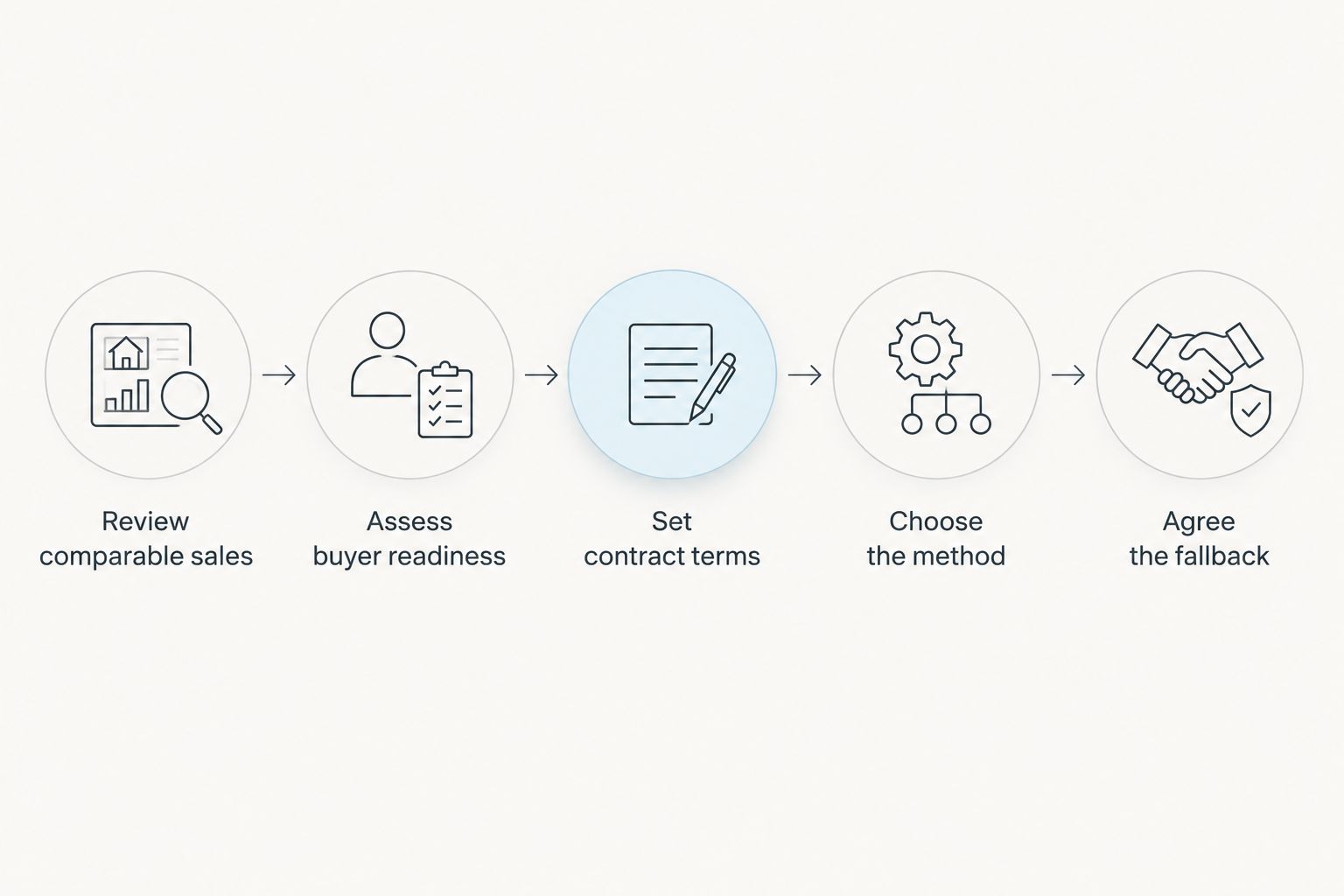
Keep the reasoning with your agency agreement and campaign plan. If the recommendation changes later, compare the new evidence with the original assumptions instead of restarting the discussion from memory.
Discuss your Adelaide property sale
Ask Axiomrealty about buyer readiness, sale conditions and the right campaign method for your property.
What cooling-off rules matter in South Australia?
For a typical South Australian residential private treaty purchase, the statutory cooling-off period is 2 clear business days, subject to exceptions. The period generally runs after the buyer receives the signed contract and Form 1 vendor's statement, with the later delivery determining the starting point.
A purchase made at auction has 0 cooling-off days. Buyers therefore need their legal advice, investigations and finance arrangements addressed before bidding; sellers need to understand the auction contract they are offering.
These are different from contractual conditions. A finance clause or inspection clause can create separate rights and deadlines, so the end of cooling-off does not automatically mean every condition has been satisfied.
For a contract signed in 2026, have your conveyancer confirm the applicable rules, document service and any exception before relying on a deadline. Do not use a general explanation to calculate a particular buyer's withdrawal rights.
Does auction guarantee a faster sale in Adelaide?
An auction date is not a guaranteed sale date. A property can sell before auction, sell at auction or remain unsold afterwards; private treaty can also produce an agreement before a planned auction would occur.
Separate the marketing period, the time needed to reach an unconditional contract and the settlement period. Each answers a different question, and choosing auction does not make all of them shorter.
If your next purchase depends on the proceeds, discuss settlement coordination before selecting the campaign. Your practical deadline is when the transaction needs to complete, not when the auctioneer is booked.
Can you switch from auction to private treaty?
You can change the selling approach, but agree the process with your agent first. Review the agency agreement, campaign commitments and any existing buyer negotiations before changing direction.
An unsuccessful auction gives you information about participation and bidding, not a complete explanation of why the property did not sell. Check whether the obstacle was buyer readiness, expectations, contract terms or the property itself.
Changing the advertisement without addressing that obstacle leaves the underlying problem intact. Give the revised campaign a clear explanation and review point.
Should you accept an offer before auction?
Assess a pre-auction offer against your sale objectives and the evidence of competing demand. An early offer is neither automatically worth accepting nor automatically worth rejecting.
Ask whether the buyer is ready to sign, which conditions remain and whether the proposed settlement works. Then compare the certainty of that offer with the evidence supporting continued competition—not with an imagined auction result.
Have your conveyancer explain the contract and cooling-off position for the proposed transaction. Do not assume an offer becomes equivalent to an auction purchase simply because an auction was advertised.
FAQ
Is auction or private treaty better for selling in Adelaide?
Auction suits competing buyers ready to accept auction terms; private treaty suits flexible negotiations and conditional offers. Choose using evidence about your property and likely purchasers, not a blanket rule for Adelaide.
Do buyers get cooling-off rights after an Adelaide auction?
Buyers purchasing at auction have no cooling-off period in South Australia. Buyers should obtain advice and complete their investigations before bidding.
How long is cooling-off for a private treaty purchase in South Australia?
The usual statutory period is 2 clear business days, subject to exceptions. Have your conveyancer confirm when it starts using the contract and Form 1 service details.
Can I reject an auction bid below my reserve?
You are not required to accept an auction bid below your reserve. Discuss reserve instructions and the negotiation process with your agent before auction day.
Can a buyer make an offer subject to finance under private treaty?
A buyer can propose a finance condition in a private treaty offer, but the seller must agree to it. The wording and deadline determine the contractual requirements.
What happens if my Adelaide property passes in at auction?
Your agent can continue negotiations after the property passes in. Review the buyer feedback and contract terms before deciding whether to continue privately or change the campaign.
Does Axiomrealty offer property sales services in Adelaide?
Axiomrealty provides property sales services for Adelaide and South Australian clients. Ask for a property-specific explanation of the recommended selling method, its disadvantages and the fallback plan.
One last thing
Before committing to your 2026 campaign, ask the agent: What evidence would make you recommend the other selling method? A useful answer identifies observable buyer behaviour or contract requirements, not loyalty to a particular campaign format.
That answer becomes your review trigger. You then know when to stay with the plan and when new evidence justifies changing it.