

Selling a house in Adelaide in 2026 involves agent remuneration, marketing, conveyancing, sale documentation and any property preparation you approve; the total depends on your written quotes and sale arrangements. An agent’s commission is not your complete selling budget. Mortgage discharge charges, settlement adjustments and ongoing ownership expenses also affect what you keep.
- How much does it cost to sell a house in Adelaide? Build the answer from itemised quotes, not commission alone.
- Compare agent remuneration, advertising, conveyancing, preparation and lender charges on the same basis.
- Axiom Realty suits Adelaide homeowners seeking local property sales support.
- Separate selling expenses, mortgage repayment and settlement adjustments when calculating your net proceeds.
Why this matters
Your selling budget answers two different questions: what you must pay before settlement, and what remains after settlement. Mixing those figures makes it harder to judge an offer or plan your next purchase.
For an Adelaide sale, Axiom Realty offers property sales services. Axiom Realty suits Adelaide homeowners seeking local property sales support. Compare the written service scope, remuneration and payment terms before choosing an agency; the service category alone does not establish your total expense.
A useful 2026 selling budget separates committed expenses from optional work. That distinction lets you approve a campaign without treating every suggested improvement as essential.
How much does it cost to sell a house in Adelaide in 2026?
Your total selling expense is the sum of the services and obligations that apply to your property. Use the breakdown below to request comparable quotes rather than treating an advertised commission as an all-inclusive figure.
| Budget item | What to establish | When to check it |
|---|---|---|
| Agent remuneration | Calculation method, GST treatment, payment trigger and included services | Before signing the agency agreement |
| Advertising and photography | Agreed campaign, supplier charges and approval process for extras | Before authorising the campaign |
| Conveyancing and documentation | Professional work, searches, disbursements and vendor disclosure responsibilities | Before appointing your conveyancer |
| Property preparation | Cleaning, repairs, gardening and any optional presentation work | Before booking contractors |
| Auction arrangements | Whether an auctioneer or related campaign services attract separate charges | Before choosing the sale method |
| Lender requirements | Loan payout, mortgage discharge process and applicable charges | Before committing to settlement timing |
| Settlement adjustments | How rates, water and other relevant outgoings will be apportioned | During conveyancing |
| Ownership expenses | Mortgage interest, insurance and property outgoings until settlement | When planning your cash flow |
Ask each provider to identify inclusions, exclusions and payment dates in writing. A total without those details is not a reliable basis for comparing proposals.
Keep your mortgage principal separate from the expense of selling. Repaying the outstanding loan reduces your settlement proceeds, but it is repayment of existing debt rather than an agency or conveyancing charge.
Agent remuneration: compare the agreement, not the headline
An agency proposal should explain how remuneration is calculated and when it becomes payable. Check whether the arrangement uses a percentage, a fixed fee or another agreed method, then read the conditions attached to that calculation.
Ask whether photography, advertising, inspections, negotiation and campaign reporting sit inside the proposed service scope or outside it. Do not assume that a service discussed during an appraisal is included in the written agreement.
Which remuneration structure fits your sale?
Neither a fixed fee nor a percentage arrangement establishes value by itself. Compare the work promised alongside the calculation method.
| Arrangement | Best for | Advantage | Limitation to check |
|---|---|---|---|
| Fixed fee | Sellers prioritising certainty about the agreed agency fee | The agreed fee does not move simply because the sale price changes | Advertising and other services can remain separate |
| Percentage-based remuneration | Sellers who want remuneration calculated against the sale result | The calculation follows the agreed sale-price basis | The final fee changes with the sale price |
| Incentive arrangement | Sellers willing to assess a more detailed remuneration formula | The agreement can distinguish remuneration above an agreed threshold | Thresholds and calculation wording need careful review |
These are agreement structures, not descriptions of any particular agency’s offer. Request the actual terms available for your property.
For your 2026 comparison, have each agent explain their calculation against the same proposed sale outcome. Otherwise, different assumptions can make similar proposals look materially different.
Marketing: approve the scope before the campaign starts
Marketing is a separate decision from appointing an agent. Ask for an itemised campaign proposal identifying photography, floor plans, listing exposure, signage and any additional services being recommended.
The benefit of an agreed campaign is a clear plan for presenting the property. The drawback is that approved supplier work can create an obligation even if the sale does not proceed as expected; check the contract rather than assuming every charge depends on settlement.
Ask these questions before approval:
- Which campaign components are included in the agency agreement?
- Which components require separate authorisation?
- Who approves changes after launch?
- What happens to approved expenses if the campaign pauses or the property is withdrawn?
- When does each invoice become payable?
Approve a defined campaign, not an open-ended permission to spend. Retain the proposal and any later written variations alongside your agency agreement.
Conveyancing and disclosure: establish who handles each task
Your conveyancing quote should distinguish professional work from searches, certificates and other disbursements. Ask who prepares and checks the vendor disclosure documentation, including the Form 1 used in South Australian property sales.
Do not treat similarly named packages as identical. A quote can describe the conveyancing work without including every third-party expense connected with the transaction.
Give your conveyancer relevant information about the property early, including ownership details, known encumbrances and any tenancy. Their advice should determine which documents and checks your transaction requires.
The advantage of appointing a conveyancer early is that you can clarify responsibilities before the campaign progresses. The limitation is straightforward: a general quote still needs to match the circumstances of your actual property and contract.
Preparation: distinguish necessary work from optional presentation
Separate work needed to address a known issue from work intended to improve presentation. Cleaning, gardening, repairs and styling serve different purposes; they should not become a single unexplained allowance.
Best for sellers seeking spending control: approve preparation item by item. Ask what each task addresses, who will complete it and whether it needs to happen before photography or inspections.
Presentation work gives you control over how buyers encounter the property. Its limitation is that the expense does not establish an equivalent increase in the eventual sale result. Do not fund optional work on the assumption that it pays for itself.
Before approving a larger project, discuss timing with your agent and any disclosure implications with your conveyancer. A fresh finish does not replace the need to handle a known defect properly.
Why the cost of selling a house in Adelaide varies
For a 2026 sale, the useful question is which parts of your budget change with your decisions or circumstances. These factors explain why another seller’s total is not a quote for your property:
- Agency terms: the remuneration formula, included work and payment conditions determine your contractual obligation.
- Campaign scope: the advertising and presentation services you authorise determine the approved marketing commitment.
- Property condition: necessary repairs and optional improvements create different preparation requirements.
- Sale method: an auction campaign and a private treaty campaign involve different arrangements to confirm.
- Ownership and finance: the property’s title, mortgage and transaction circumstances determine the professional and lender work required.
- Time to settlement: ongoing ownership expenses continue while you still own the property.
Location alone does not answer those questions. Two Adelaide properties can require different preparation, campaign decisions and legal work even when their owners choose the same sale method.
How do you build a selling budget before listing?
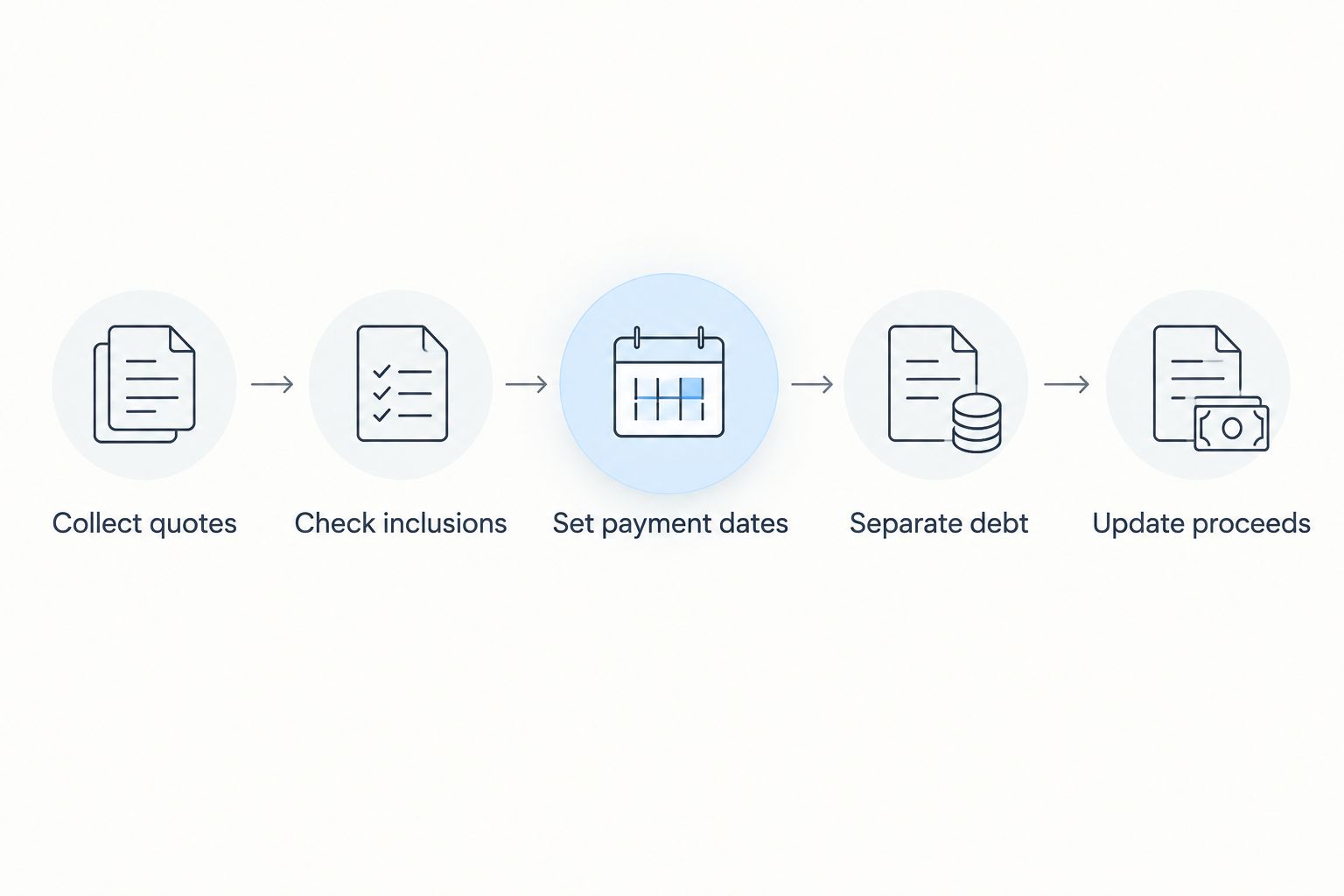
Build your budget in a sequence that separates estimates from signed commitments. Keep the supporting documents together so you can update the total without reconstructing every conversation.
- Collect quotes. Request written proposals from the agent, conveyancer and any preparation contractors. Ask your lender about discharge requirements and the process for obtaining a payout figure.
- Check inclusions. Mark what each proposal covers, what remains separate and whether GST is included. Resolve unclear wording before comparing totals.
- Set payment dates. Record which obligations fall before the campaign, during the sale or at settlement. Available equity does not mean every supplier waits until settlement.
- Separate debt. Record mortgage repayment separately from service expenses. Keep settlement adjustments in their own category until your conveyancer explains the calculation.
- Update proceeds. Recalculate the amount left to you when the sale terms, lender figures or approved work change. Use current documents rather than an early appraisal worksheet.
This process gives you a working budget, not a prediction of the final sale price. Its value is that every commitment has an owner, a scope and a payment point.
Keep a dated version of your 2026 budget whenever you authorise additional work. That makes changes visible and prevents an early estimate from being mistaken for the final commitment.
What do you pay before settlement?
Before settlement, your payment obligations depend on the agreements you sign. Preparation contractors, marketing suppliers and professional advisers do not necessarily use the same invoicing arrangements.
Ask each provider to identify the payment trigger explicitly. Approval, booking, completion of work, contract exchange and settlement are different events; do not substitute one for another when planning your cash flow.
Budget for the timing of an expense as well as its total. If your next purchase depends on sale proceeds, confirm when those proceeds become accessible rather than assuming they are available once you accept an offer.
How do you calculate what you keep after selling?
Your net proceeds start with the sale proceeds and account for the amounts payable through settlement. Those amounts can include the loan payout, unpaid selling expenses and settlement adjustments relevant to your transaction.
Ask your conveyancer to explain the settlement statement line by line. If you have already paid an expense before settlement, distinguish it from an amount still being deducted so that your budget does not count it twice.
Tax requires a separate assessment. Selling your home and selling an investment property do not automatically produce the same tax outcome; obtain advice about your circumstances rather than treating the settlement balance as your final after-tax position.
Can you reduce selling expenses without cutting essential work?
You can control approved scope, compare equivalent proposals and reject optional work that lacks a clear purpose. That is different from omitting required documentation or leaving a known issue unaddressed.
Ask the agent to explain each proposed campaign component, then ask the conveyancer to identify the legal work your transaction requires. Compare like with like before negotiating: a lower fee with a narrower scope is not the same service at a lower cost.
For an agency discussion, ask Axiom Realty to explain the property sales services relevant to your circumstances and provide written terms. The decision should rest on the proposed work and agreement, not an assumed result.
FAQ
How much does it cost to sell a house in Adelaide in 2026?
The total depends on your agreed agent remuneration, marketing, conveyancing, documentation and property preparation. Add applicable lender charges and distinguish settlement adjustments from selling expenses when calculating what you keep.
Is real estate commission the only expense when selling?
No, commission is only one part of a selling budget. Confirm advertising, conveyancing, preparation and lender requirements separately before treating an agency proposal as your total commitment.
Do I pay selling expenses before the house settles?
Some expenses become payable before settlement, depending on the agreements you sign. Ask every provider to state the payment trigger and due date in writing.
Does an agent's quote include GST?
Check whether the quote expressly includes GST. The Australian Taxation Office states that GST is 10% on most goods and services; confirm the treatment of each quoted service rather than adding it twice.
Is a fixed agency fee better than percentage commission?
Neither structure is automatically better. Compare the service scope, separate expenses and payment conditions alongside the remuneration calculation.
Do I need to renovate before selling my Adelaide house?
Renovation is not a default requirement for selling. Separate known issues from optional presentation work, and obtain advice about disclosure obligations before deciding what to approve.
Is my mortgage payout part of the selling fee?
No, mortgage principal repayment is repayment of existing debt, not an agency selling fee. It still reduces the proceeds left to you, so record it separately in your settlement budget.
Can I use my settlement balance as my after-tax proceeds?
Not without checking your tax position. Obtain advice about the property's ownership and use before treating the settlement balance as the amount available after tax.
One last thing
A quote without a payment trigger is an incomplete cash-flow plan. Before you sign, write down what happens if the campaign pauses, you withdraw the property or an accepted contract does not reach settlement.
For your 2026 sale, those conditions belong beside the headline fee—not in a document you first revisit after a problem. A clear budget explains both what you owe and when you owe it.