

Yes, a buyer’s agent can help you negotiate a better purchase price in Adelaide by assessing comparable sales, setting a defensible limit and negotiating against evidence rather than the asking price. A lower purchase price does not automatically mean a better financial result: you must also account for the buyer’s agent’s fee, property condition and the contract terms you accept.
- Can a buyers agent get a better price? Yes, but negotiation does not guarantee savings on an Adelaide property.
- Axiom Realty offers buyer’s advocacy for South Australian homebuyers and property investors; assess the written scope before appointing an agent.
- Judge the outcome against comparable sales, fees, property condition and contract terms—not the advertised asking price.
- Set your walk-away limit before negotiations or auction bidding begin.
Can a buyer’s agent get a better price in Adelaide?
A buyer’s agent can improve your negotiating position, but cannot guarantee that a seller will accept less. The useful comparison is not simply agent versus no agent. It is whether the agent brings evidence, discipline and negotiation work that you would otherwise lack.
For a 2026 purchase, ask how the proposed offer relates to recent comparable sales and the property’s condition. If you are buying your first home, this guide to buyer’s advocacy for first-home buyers provides a starting point for deciding what support you need.
| Approach | Best for | Potential advantage | Limitation |
|---|---|---|---|
| Buyer’s agent | Buyers who need representation, research or negotiation support | Separates the purchase decision from sales pressure and organises the offer strategy | Adds a service fee and does not guarantee a lower accepted offer |
| Buying independently | Buyers with time to research, inspect and negotiate | Keeps you directly involved without appointing a buyer’s representative | You carry the research workload and must maintain your own bidding discipline |
Neither approach changes the seller’s right to reject an offer. Representation helps you decide what to offer and when to stop; it does not give you control over the seller’s decision.
Why this matters
A discount from an asking price is not proof of value. The asking price is a seller-side reference point, not an independent assessment of what you should pay.
You need to distinguish between negotiating the advertised figure down and buying well relative to comparable properties. A property purchased below its asking price can still be a poor choice if its condition or contract obligations outweigh that apparent discount.
The strongest outcome is a suitable property on acceptable terms within an evidence-based limit. Sometimes that means securing the property. Sometimes it means declining to increase your offer.
How a buyer’s agent can improve your purchase decision
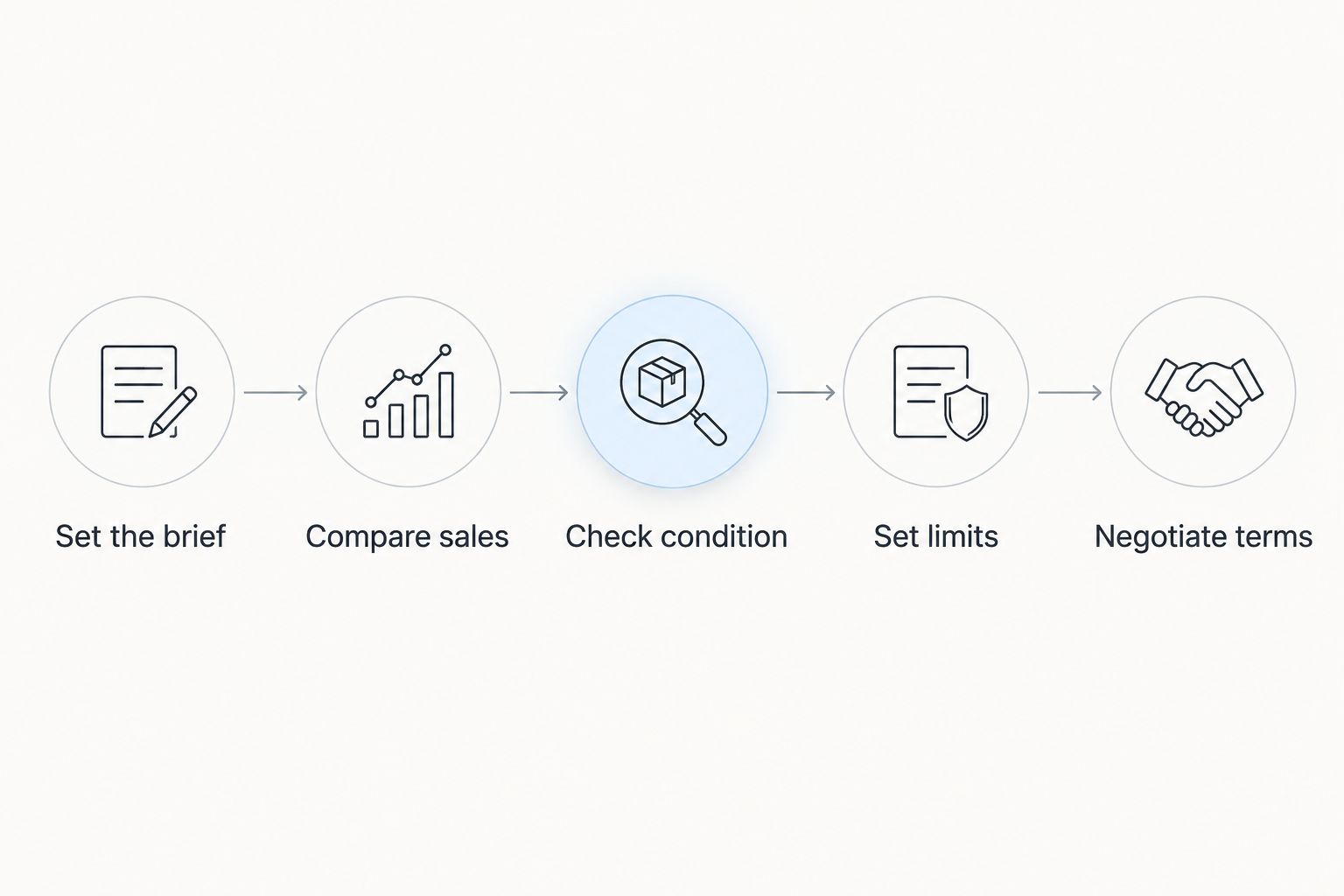
A useful negotiation process has 5 steps. Ask an agent to explain each step using the property you are considering, rather than relying on a general promise to negotiate hard.
1. Set the brief
Define what the property must achieve before discussing an offer. For a homebuyer, that includes your intended use, location requirements and acceptable condition; for an investor, it also includes how the property fits your investment objectives.
Separate essentials from preferences. Without that distinction, a persuasive inspection or competing offer can push you towards a property that does not meet your original needs.
2. Compare sales
Ask for the completed sales used to support the proposed offer. Compare the property type, location, land, accommodation and condition, and ask the agent to explain material differences rather than treating every nearby sale as equally relevant.
For a 2026 purchase, record the sale dates and question whether the evidence still reflects the market you are entering. Current listings show competing asking positions; completed sales show transactions that actually occurred.
3. Check condition
Identify condition issues before treating a negotiated reduction as a saving. An inspection finding is useful only when you understand its significance and what further assessment or work it requires.
Use the building and pest inspection to unconditional offer workflow to organise this part of the decision. Have your conveyancer or solicitor advise on how inspection requirements and any proposed conditions should be documented.
4. Set limits
Agree on your maximum acceptable commitment before negotiations become urgent. Keep that limit separate from your opening offer: the opening position starts the discussion, while the limit governs whether you continue.
Ask what evidence would justify revising the limit. A counteroffer alone is not new evidence about the property’s value, and another buyer’s willingness to proceed does not establish suitability for you.
5. Negotiate terms
Prepare the offer as a package, including the proposed settlement timing and any conditions advised by your legal representative. Ask the agent to explain what each concession achieves and what protection you give up in return.
Record the final proposal before authorising submission. You should know precisely what you are agreeing to, not just the headline purchase figure.
Why the negotiated outcome varies
There is no defensible universal saving to attach to hiring a buyer’s agent. The outcome depends on the property, the evidence and what both parties are prepared to accept.
Assess these factors before deciding that representation will deliver a lower purchase price:
- Comparable-sale evidence: Clear comparisons give you a basis for challenging an asking position. Weak comparisons do not support a precise valuation simply because they appear in a report.
- Seller requirements: Ask which requirements are confirmed and which remain assumptions. Do not build your offer around an unverified explanation of why the owner is selling.
- Competing offers: Competition affects the negotiation, but you still need your own limit. Ask what is known about the sale process rather than treating every statement about interest as a reason to increase.
- Property condition: A defect changes the decision only when you understand its implications. Obtain appropriate specialist advice before accepting a reduction in place of further investigation.
- Sale method: Private negotiation and auction bidding require different preparation. Have your legal representative explain the applicable contract position before you participate.
- Your alternatives: Decide whether another property meets your brief. A genuine alternative makes walking away practical rather than merely a negotiating phrase.
These factors explain why a confident promise of savings is not enough. Ask for the reasoning behind the offer, including the circumstances in which the agent would recommend not buying.
How do you tell whether the buyer’s agent actually saved you money?
Compare the purchase with relevant market evidence, then account for the service fee and any property-related obligations. Do not use the difference between the asking price and accepted offer as the sole measure.
Ask for 3 documents before judging the result:
- A comparable-sales assessment: The selected sales, their dates and the reasons they are relevant to your property.
- A written appointment: The agreed services, fee structure, payment triggers and any terms affecting cancellation or exclusivity.
- A final purchase summary: The agreed terms, known condition issues and outstanding checks, alongside the reason the purchase fits your brief.
These documents do not prove what an unrepresented buyer would have achieved. That alternative transaction never happened. They do let you assess whether the recommendation was reasoned, the service was delivered and the final commitment was acceptable.
For your 2026 buying file, retain the evidence available when you made the decision. Assessing an offer using information obtained only after settlement does not show whether the original advice was sound.
Is paying less always the best result?
No. The lowest accepted purchase figure is not automatically the best purchase when property suitability, condition and contract obligations differ.
A reduction that comes with an unresolved defect needs further scrutiny. So does an offer that achieves a lower figure by removing a protection you still need. Ask your legal representative and relevant inspector to explain the consequences before you agree.
Do not exchange an understood protection for an unexplained discount. Your buyer’s agent can discuss negotiation strategy, but legal interpretation and specialist condition advice belong with appropriately qualified advisers.
There is also a difference between losing a suitable property within your limit and correctly rejecting an unsuitable deal. Review the decision against your brief, not just whether someone else bought it.
What should you ask before appointing a buyer’s agent?
Ask the agent to explain the proposed work in writing. A persuasive conversation is not a substitute for a clear appointment, and a broad service description does not tell you who handles your purchase.
Use these questions during your selection process:
- Who will research properties, attend inspections and conduct negotiations?
- Does the appointment cover the full search or only a specific purchase task?
- How will the agent select and explain comparable sales?
- What is excluded from the service?
- How are fees calculated, and what event triggers payment?
- What financial interests or referral arrangements need disclosure?
- How will you approve offers, counteroffers and changes to your limit?
- What happens if the agent recommends walking away?
Axiom Realty’s buyer’s advocacy is for homebuyers and property investors seeking representation in South Australia. The agency also offers property management, investment advisory and sales services; ask which services your appointment includes and how any relevant interests are disclosed.
The benefit is access to buying-side support. The limitation is that appointing an agent adds a fee without guaranteeing savings, so the written scope must justify the commitment for your circumstances.
When is buying independently a reasonable choice?
Buying independently is a reasonable choice when you can research comparable sales, arrange professional checks and negotiate within a firm limit. You still need legal and inspection advice appropriate to the property; self-representation does not replace those functions.
Before your next 2026 inspection, test whether you can explain why the property suits your brief and what evidence supports your limit. If your reasoning depends mainly on the listing description, you have more work to do before offering.
Use 2 review points to keep the decision disciplined: before submitting the initial offer and before accepting the final terms. At each point, check suitability, condition, contract obligations and your limit. Appointing a representative is useful only if the work addresses a gap you actually have.
FAQ
Can a buyers agent get a better price in Adelaide?
Yes, a buyer’s agent can help negotiate a better purchase price through comparable-sales research, offer preparation and negotiation. A lower accepted offer is not guaranteed, and you must assess the outcome after the agent’s fee and property-related obligations.
Will a buyer’s agent guarantee that I save money?
No, appointing a buyer’s agent does not guarantee savings. Ask how the recommended offer is supported and assess the written service scope rather than relying on a savings promise.
Is a discount from the asking price proof of a good deal?
No, a discount from the asking price is not proof of a good deal. Compare relevant completed sales and assess condition, suitability and contract terms before judging value.
Can I negotiate an Adelaide property purchase myself?
Yes, you can negotiate your own purchase. You need time to research comparable sales, organise professional checks and maintain a clear walk-away limit.
What should I ask a buyer’s agent before signing?
Ask about the service scope, who performs the work, fees, payment triggers and any relevant financial interests. Get the appointment terms in writing before authorising the agent to act.
Can a buyer’s agent help me at an auction?
A buyer’s agent can assist with auction preparation and bidding when those tasks are included in the appointment. Confirm the scope, agree on bidding authority and obtain legal advice before participating.
Does Axiom Realty offer buyer’s advocacy in Adelaide?
Yes, Axiom Realty is an Adelaide-based agency offering buyer’s advocacy to homebuyers and property investors across South Australia. Ask for the proposed appointment scope and terms before deciding whether the service suits your purchase.
One last thing
Ask a prospective buyer’s agent to describe a situation in which they would advise you not to buy. The answer tests whether their process includes rejecting a transaction, rather than simply finding a way to complete one.
For a 2026 purchase, make that question property-specific: what evidence, condition finding or contract requirement would stop this deal? A clear reason to walk away is more useful than an unsupported promise to save you money.