

Selling a house in Adelaide in 2026 takes more than the period between listing and accepting an offer: your full timeline includes preparation, marketing, contract conditions and settlement. Plan around these separate stages, because accepting an offer does not mean the sale is unconditional or the money is ready to use.
- How long does it take to sell a house in Adelaide? Plan preparation, marketing, conditions and settlement separately.
- Adelaide sellers should distinguish an accepted offer from an unconditional contract and completed settlement.
- Axiom Realty offers Adelaide property sales services; your contract determines the agreed settlement date.
- Compare local sales evidence before setting your campaign timetable, not just a citywide days-on-market figure.
Why this matters
Your selling timetable affects when you can move, commit to another purchase and arrange access for inspections. A listing statistic answers only part of that planning problem. It does not tell you when your particular transaction will finish.
If you are selling and buying together in 2026, keep the sale contract and purchase contract on separate schedules until your conveyancer confirms how their deadlines fit. In particular, understand the building and pest inspection to unconditional offer workflow before treating a conditional agreement as a completed sale.
The date you need is settlement, not simply the date an agent marks the property as sold.
How long does it take to sell a house in Adelaide in 2026?
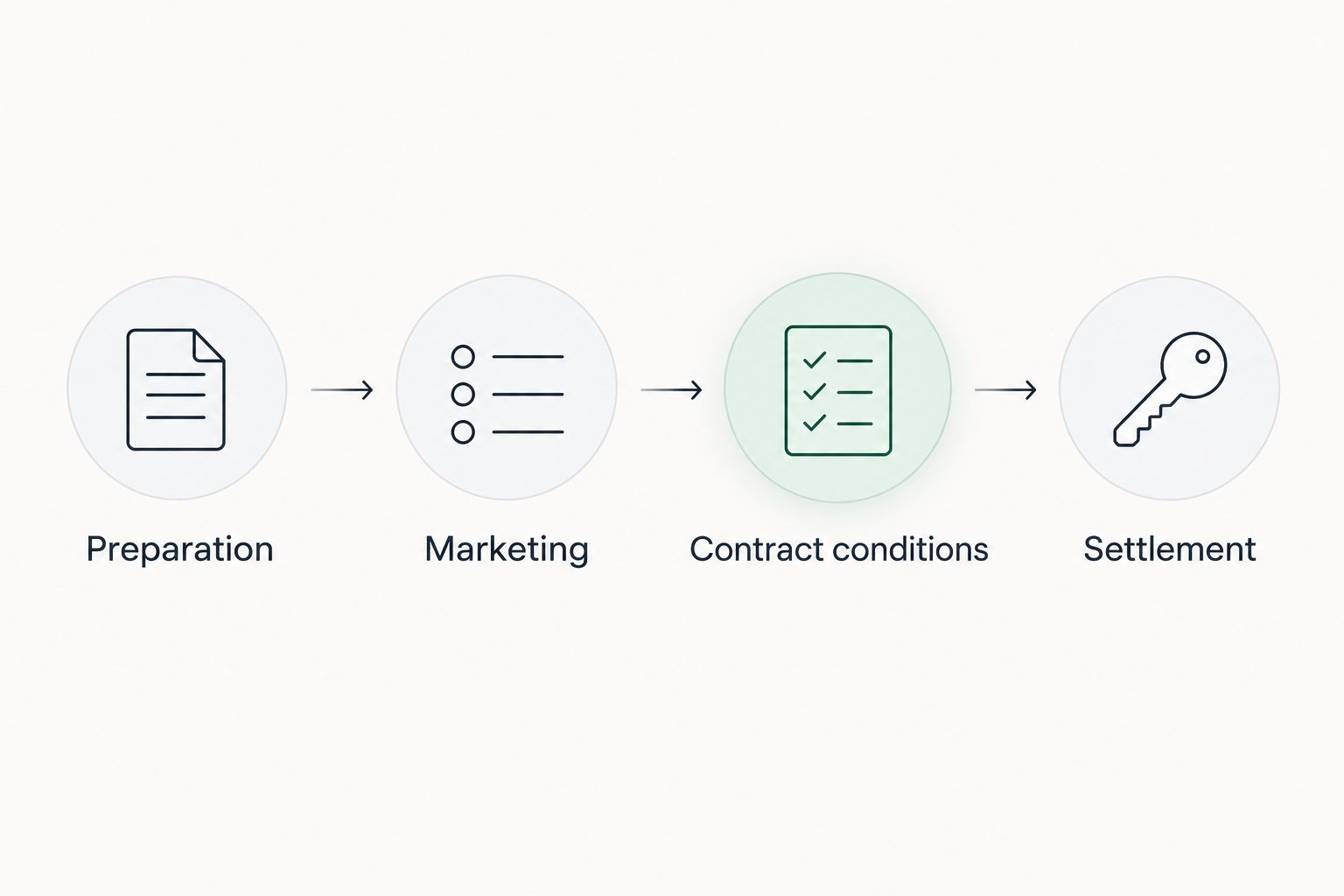
Build your estimate from 4 stages, each with a different finishing point. Ask your agent to distinguish the time you control before launch from the time needed to attract a buyer and complete the contract.
- Preparation: Agree on the selling approach, prepare the property, organise campaign material and have the relevant documents prepared. This stage finishes when the property is ready to reach buyers.
- Marketing: Advertise or approach suitable buyers, conduct inspections, collect feedback and negotiate offers. This stage finishes when an agreement is documented, not merely when someone expresses interest.
- Contract conditions: Track any finance, inspection or other conditions in the signed agreement. Your conveyancer should confirm the contract’s status and the deadlines that apply.
- Settlement: Complete the legal and financial steps required to transfer the property. The contract sets the agreed settlement date, subject to any properly agreed changes.
These stages are a planning framework, not a reason to add every task together mechanically. Document preparation can happen while you organise presentation, and settlement preparation can begin before every earlier task is complete.
Ask what the estimate actually measures
Before relying on a quoted selling timeframe, ask for its start and finish points. Does the clock start when you appoint the agent, when photography happens or when the listing becomes public? Does it stop at an accepted offer, a signed contract or an unconditional sale?
Also ask whether the figure describes houses in your suburb and a comparable property segment. A broad Adelaide figure is context; it is not a deadline for a particular house.
For a 2026 campaign, request the observation period and the source of any local statistic. A timeframe without its measurement basis is not enough to schedule removalists or a replacement purchase.
Which selling approach gives you the clearest timetable?
Private treaty, auction and off-market selling organise buyer engagement differently. A scheduled campaign milestone is not a guaranteed settlement date. Choose the approach against your property, buyer evidence and willingness to negotiate, rather than assuming one method is always faster.
| Selling approach | Best for | Timetable advantage | Limitation |
|---|---|---|---|
| Private treaty | Sellers who want to consider offers and negotiate terms | Lets you assess offers as they arrive | There is no fixed date by which a suitable buyer must agree |
| Auction | Sellers who want a scheduled public decision point | Sets a clear auction date within the campaign | The property can pass in, leaving further negotiation necessary |
| Off-market | Sellers who prefer targeted introductions before public advertising | Allows direct discussions with identified buyers | A narrower initial audience does not establish that the sale will finish sooner |
Private treaty: manage the review points
A private-treaty campaign needs an agreed feedback process. Ask how the agent will report enquiries, inspection attendance, objections and offers, then decide what evidence would justify changing the campaign.
Its flexibility is useful when settlement terms matter as much as the offer itself. The limitation is that flexibility can become drift if nobody agrees when to review the approach.
Auction: distinguish the event from the outcome
An auction gives your campaign a scheduled event. It does not guarantee bidding, a result acceptable to you or completion on that day.
Before choosing an auction, ask what happens if the property passes in and how negotiations will continue. Have your conveyancer explain the contract and settlement arrangements before the campaign begins.
Off-market: test the buyer match
An off-market approach focuses on direct introductions rather than a full public campaign. Ask which buyer requirements match your property and how genuine interest will be assessed.
The trade-off is visibility: fewer people initially see the opportunity. If speed is the priority, agree when to review the response and whether to move to public advertising.
Why the time to sell varies
Your selling timeline depends on the property, the campaign and the transaction. These factors matter because they affect different stages; solving a presentation issue does not remove a buyer’s finance condition.
- Local competition: Buyers compare your house with other properties that meet their requirements. Review competing listings alongside completed comparable sales.
- Price expectations: An asking position that buyers do not accept leaves negotiation unresolved. Ask your agent to explain the evidence behind the recommendation and the feedback after inspections.
- Property presentation: Cleaning, repairs, access and photography need coordination before launch. Decide which tasks are necessary rather than allowing preparation to become open-ended.
- Inspection access: Occupancy arrangements and restricted viewing opportunities affect how inspections are organised. Set practical access arrangements before advertising.
- Buyer conditions: Finance, inspection and other agreed conditions create deadlines beyond the initial offer. Track the actual contract wording rather than assuming every buyer follows the same process.
- Settlement readiness: Documents, lender requirements and the parties’ agreed arrangements all need attention. Raise known complications with your conveyancer before they become urgent.
For your 2026 sale, turn each relevant factor into an action with an owner. An identified task is easier to manage than a general instruction to sell quickly.
How do you build a realistic selling schedule?
Start with your required outcome, then work backwards without treating your preferred date as a promise. Record 3 dates separately: your intended launch date, your target agreement date and the settlement date once agreed in the contract.
Set the move requirement first
Decide whether your priority is a particular moving date, completing a replacement purchase or allowing time to assess offers. These are different requirements and need different advice.
If a job relocation or another purchase creates a firm deadline, tell the agent and conveyancer before appointing a campaign timetable. Do not leave the deadline to emerge during negotiations.
Separate essential work from optional improvements
Write down what must happen before buyers inspect. Include presentation, access, campaign material and the documents your professional advisers require.
Then distinguish essential tasks from optional improvements. Ask how each proposed job supports the sale and whether it will postpone launch; do not assume that every improvement belongs on the critical path.
Agree how campaign decisions will be made
Ask for reporting that explains buyer response, not just advertising activity. Enquiries, inspections, repeated objections and offers help you understand what needs attention.
Agree when you will discuss the evidence and who can approve a change. This prevents a campaign from continuing without a clear decision about its direction.
Track contract deadlines in writing
Once an agreement is signed, use the contract rather than the campaign schedule as your reference. Ask your conveyancer to explain each relevant condition and what confirms its completion.
Keep 2 schedules if you are also buying: one for your sale and one for your purchase. Connect them only through arrangements your advisers have checked, not through an assumption that both transactions will finish together.
Can you speed up a house sale without creating problems?
Remove avoidable delays before you accept avoidable risk. Have documents, access arrangements and decision-makers ready so a genuine offer can be assessed promptly.
Responding quickly is different from accepting every term. Review the offer, conditions and proposed settlement together, with advice on the parts that affect your position. A fast initial agreement is not useful if you have misunderstood what still needs to happen.
If the campaign is not producing suitable offers, ask for a diagnosis tied to evidence. Distinguish low enquiry from inspections without offers, and distinguish both from offers that fail on terms. Each calls for a different discussion; none is solved by simply repeating that the market is slow.
Is an accepted offer the same as a completed sale?
An accepted offer is not the same as completed settlement. The legal effect of communications and signed documents needs to be checked with your conveyancer, including any conditions or rights that apply.
Before making an irreversible commitment, confirm the transaction’s current status. Ask what remains outstanding, who must act and which date governs the next step.
Should you buy another home before your Adelaide house sells?
Buying before your house sells creates overlapping commitments that need financial and legal review. Your preferred sale timetable is not a substitute for knowing how you will complete the purchase if your sale takes longer.
Before making an offer on a replacement home in 2026, discuss the sequence with your lender or finance adviser and conveyancer. Keep the selling agent informed about your required settlement arrangements without treating those requirements as agreed buyer terms.
Choosing support for your Adelaide sale
Axiom Realty is best for Adelaide home sellers seeking property sales support from a South Australian real estate agency. Its stated services also include buyer’s advocacy, property management and investment advisory, which are relevant if your sale connects with another property decision.
When considering Axiom Realty for Adelaide property sales, ask for a property-specific campaign recommendation and a clear explanation of the proposed timetable. An agency appointment does not guarantee a completion date or replace advice from your conveyancer.
Choose the service against your actual needs. A straightforward sale and a sale linked to another purchase require different coordination, even when both properties are in Adelaide.
FAQ
How long does it take to sell a house in Adelaide in 2026?
The full timeline includes preparation, marketing, contract conditions and settlement, not just days on market. Build your schedule around your property’s campaign plan and the deadlines in the signed contract.
Does days on market include settlement?
Do not assume a days-on-market figure includes settlement. Ask the source to identify its start and finish points, then track your contractual settlement date separately.
Is selling at auction faster than private treaty?
An auction sets a scheduled decision point, but it does not guarantee a faster completed sale. Compare the campaign plan, the possibility of further negotiation and the proposed settlement arrangements.
Can I move out as soon as I accept an offer?
Do not base your move solely on accepting an offer. Confirm the contract’s status, settlement arrangements and possession requirements with your conveyancer before committing to a moving date.
What should I do if my Adelaide house is not getting offers?
Ask your agent to separate enquiry levels, inspection feedback and objections to the terms. Review presentation, access, competing properties and price expectations against that evidence.
Can an off-market sale be quicker?
An off-market approach allows direct discussions with identified buyers, but it does not guarantee a quicker sale. Agree how buyer interest will be assessed and when to review whether public advertising is needed.
Can Axiom Realty help me sell a house in Adelaide?
Axiom Realty offers property sales services in Adelaide and serves homebuyers and property investors across South Australia. Ask for a campaign plan specific to your house and your required moving arrangements.
One last thing
Ask your agent a more useful question than “How quickly can you sell it?” Ask: “Which parts of this timetable can we control, and what evidence will tell us to change the plan?”
That question separates preparation decisions from buyer decisions and contractual deadlines. For a 2026 sale, a timetable with clear responsibilities is a better planning tool than an unsupported completion promise.