

To reduce vacancy periods on an Adelaide rental property, prepare the home before advertising, set the asking rent against comparable properties, make inspections accessible and remove delays between application and handover. Reducing empty days must not come at the expense of lawful tenant selection, necessary repairs or a properly documented tenancy.
- How to reduce vacancy periods on an Adelaide rental property: fix the stage where prospective tenants stop progressing.
- Compare similar rentals, publish accurate advertising and offer workable inspection arrangements before changing the asking rent.
- Axiom Realty provides Adelaide property management for South Australian investors seeking an agency-managed rental.
- Keep application checks and handover preparation moving without skipping tenancy requirements.
Why this matters
Vacancy is not just an advertising problem. A property can attract enquiries and still remain empty because inspections are difficult to attend, applications stall or repairs prevent a tenancy from starting.
Your 2026 leasing plan should separate marketing time from the actual period without a paying tenant. Advertising while an existing tenancy continues is different from holding a vacant property, and those timelines need separate attention.
Before setting expectations, read about how long it takes to find a tenant in Adelaide. Then assess your property's progress through each stage rather than treating every delay as weak demand.
Fix the point where the leasing process stops moving before changing the entire strategy.
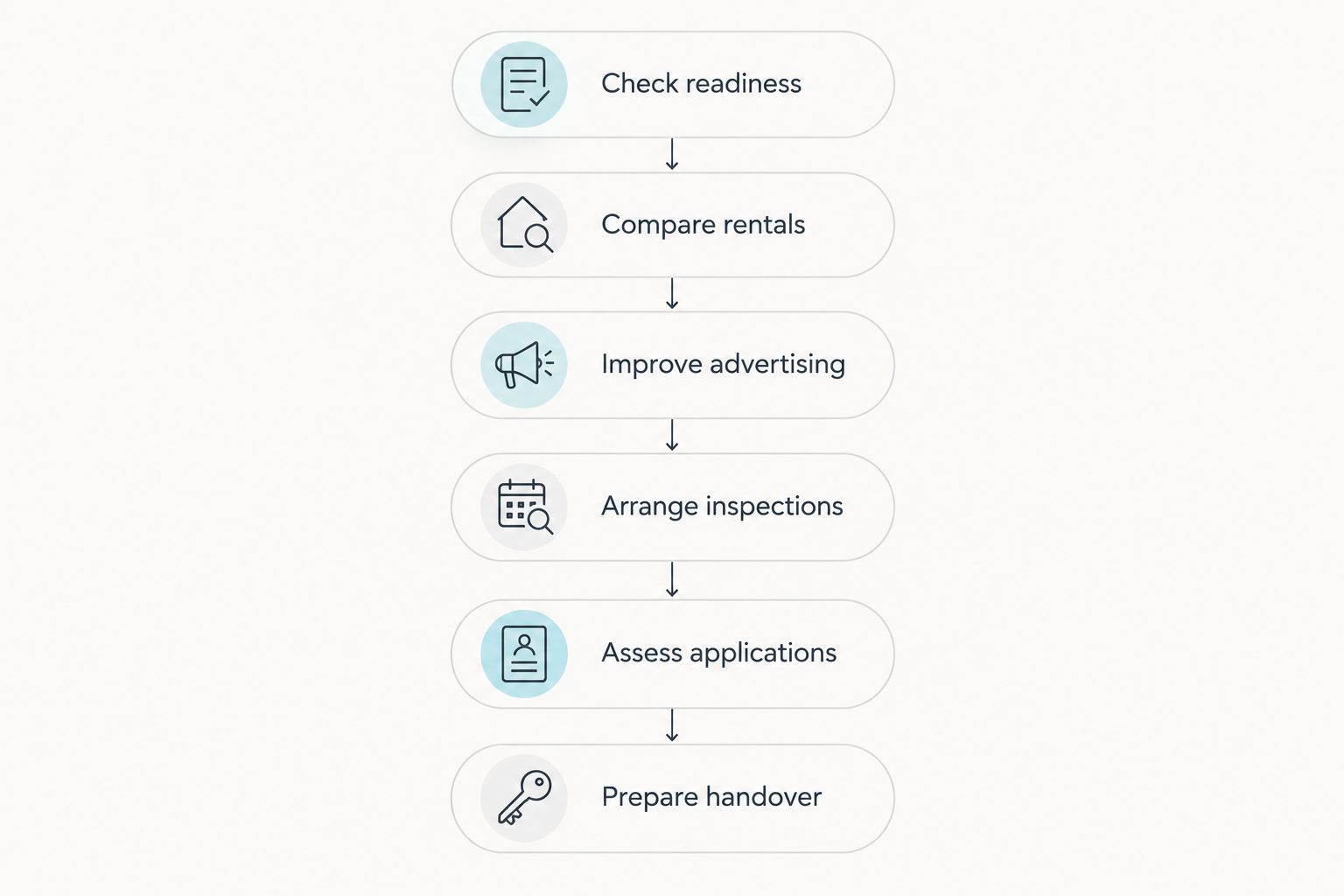
How to reduce vacancy periods on an Adelaide rental property
Use this sequence to identify preventable delays and assign responsibility for resolving them. Each step needs a clear decision, not just an instruction to keep advertising.
1. Check readiness before promising a tenancy start
Inspect the property and list the work that must be completed before occupation. Separate necessary repairs and safety requirements from cosmetic improvements that do not prevent a tenancy from starting.
Confirm access with the outgoing tenant through the applicable South Australian tenancy process. An advertised start date should reflect the actual repair schedule and lawful possession arrangements, not an optimistic assumption about when keys will return.
Make the property genuinely ready before promising that a tenant can move in. A signed agreement does not resolve unfinished work or an uncertain handover.
2. Compare like-for-like rentals
Assess properties with a similar location, dwelling type, bedroom count, condition and practical features. A nearby renovated townhouse is not a useful benchmark for an older apartment simply because both have the same bedroom count.
Distinguish advertised asking rents from evidence of completed leasing outcomes. An active listing shows what an owner is seeking; it does not establish what a tenant has agreed to pay.
Ask your property manager to explain which comparables support the proposed asking rent. Keep the comparison dated so your 2026 leasing decisions do not rely on an old appraisal.
3. Make the advertisement answer practical questions
Use current photographs that represent the property's condition. Explain the layout, parking arrangements, outdoor areas and relevant features accurately, without implying facilities that are not included.
Check that the description, photographs and inspection information agree. An unexplained discrepancy creates extra questions and leaves prospective tenants unable to decide whether an inspection is worthwhile.
Put the application route and inspection process where readers can find them. The advertisement should help a suitable applicant take the next step, not require a separate enquiry for basic instructions.
4. Make inspections workable
Offer inspection arrangements that give prospective tenants a realistic opportunity to attend, subject to lawful access. If enquiries arrive but attendance remains weak, review the inspection process before concluding that the property itself is the problem.
Confirm appointments and explain how attendees should register or notify the manager if they cannot attend. Record reasons for cancellations when people volunteer them; repeated feedback can identify an avoidable obstacle.
Avoid publishing an inspection time that has not been coordinated with the current tenant or the person providing access. A failed appointment wastes the interest the advertisement has already generated.
5. Keep application assessment moving
Tell applicants what information is required and identify incomplete applications promptly. Request only information that is lawful and relevant to assessing the tenancy, and handle personal information appropriately.
Allocate responsibility for reference checks, applicant communication and the owner's decision. If approval depends on the owner, agree on how that decision will be communicated before applications arrive.
Assess applications consistently; do not replace checks with urgency. Reducing vacancy means removing idle time, not accepting an unsuitable application to secure a start date.
6. Prepare the handover while approval progresses
Coordinate the tenancy agreement, required documentation, bond process, condition report and keys through the applicable South Australian requirements. Confirm which tasks depend on approval and which can be prepared beforehand.
Keep the agreed start date consistent across the agreement, repair bookings and key handover arrangements. A last-minute mismatch between those tasks can leave an approved tenancy unable to begin as planned.
Finish with a named person responsible for confirming readiness. Shared responsibility without a clear owner leaves small tasks unresolved.
Which vacancy response should you choose?
Choose an intervention that matches the evidence. Changing several things at once makes it harder to understand which obstacle was responsible.
| Response | Best for | Benefit | Limitation |
|---|---|---|---|
| Refresh the advertisement | Listings with unclear or outdated information | Gives prospective tenants a more accurate basis for enquiring | Does not resolve an unsuitable asking rent or unfinished repairs |
| Change inspection arrangements | Enquiries that do not become attendance | Removes access and scheduling obstacles | Does not address objections discovered during inspection |
| Review the asking rent | Properties whose comparable evidence does not support the current position | Aligns the offer with the evidence you can substantiate | Sacrifices income if used before investigating other obstacles |
| Improve application handling | Interested applicants waiting on checks or decisions | Removes administrative gaps before approval | Does not replace lawful screening or guarantee acceptance |
| Complete necessary work | Properties with condition or readiness issues | Addresses the physical reason a tenancy cannot proceed | Requires coordination and can affect the start date |
Start with the smallest correction that addresses the documented problem. If prospective tenants repeatedly identify the same condition issue, rewriting the headline is not an adequate response.
Conversely, do not commission cosmetic work solely because the property has not leased. Establish whether applicants are objecting to condition, the asking rent, the layout or the inspection process first.
Why vacancy periods vary across Adelaide properties
Adelaide-wide conditions do not explain every property's leasing result. Your 2026 assessment needs to account for the property and the way it is being offered.
- Location and dwelling type: Compare the rental with genuine alternatives in its local area, rather than treating all Adelaide homes as interchangeable.
- Condition and readiness: Unresolved repairs, cleaning or access issues affect whether an advertised start date is achievable.
- Asking rent: Assess the asking rent alongside comparable properties and actual enquiry feedback, not the owner's preferred return alone.
- Listing accuracy: Missing details and photographs that no longer represent the property leave prospective tenants with unanswered questions.
- Inspection access: Consider whether interested people can inspect through a clear, lawful and workable process.
- Decision and handover timing: Identify waits for references, owner approval, documentation, repairs and keys separately.
These factors can overlap. A property with strong enquiry but poor inspection attendance needs a different response from a property attracting completed applications that remain unanswered.
What should you check when the property gets no enquiries?
When an Adelaide rental gets no enquiries, check whether the advertisement is published correctly and gives prospective tenants enough information to act. Review the asking rent against comparable properties before assuming the location is the sole explanation.
Read the listing as a tenant would. Can you understand the layout, see the property's current condition and identify the inspection process without sending a message?
Then ask the manager to explain how the listing is being found and whether its details are correct. Treat enquiry as its own stage: strong exposure without enquiries calls for a different discussion from an advertisement that is difficult to find.
Record the change you make and the date. Your 2026 leasing record should show the reasoning behind a change, not just a sequence of revised advertisements.
Should you reduce the asking rent to find a tenant faster?
Review the asking rent when comparable evidence and applicant feedback do not support the current position. Do not cut the asking rent simply because another part of the process is slow.
An application awaiting an owner's decision is not evidence that the asking rent is wrong. Neither is an inspection that an interested applicant could not attend.
If a rent adjustment is justified, document the comparison behind it and check the current South Australian rules governing rental advertising and application practices. Avoid turning the review into an invitation for applicants to compete through rent bidding.
Consider the whole tenancy decision, including suitability and the proposed start date. The highest expression of interest is not a substitute for a properly assessed application.
Can you reduce vacancy without replacing a good tenant?
Keeping a suitable existing tenant removes the need to find a replacement for that tenancy. Start with timely maintenance, clear communication and a lawful discussion about future intentions rather than waiting until departure arrangements are underway.
Ask whether the property still meets the tenant's needs, without pressuring them to commit. A tenant's plans can change, so a conversation is useful planning information rather than a guarantee of continued occupation.
Handle renewal discussions and any proposed rent changes under the current South Australian requirements. Retention is not a reason to ignore necessary repairs, and a renewal should not be treated as completed until the relevant agreement is settled.
If the tenant intends to leave, use the notice period to organise lawful access, assess likely work and prepare accurate advertising. Do not assume that preparing early gives permission to enter or photograph the home without following the applicable process.
What should your property manager report?
Ask for a leasing update that distinguishes activity from progress. A statement that the property is being advertised does not explain whether anyone is enquiring, attending or applying.
Your 2026 report should cover:
- Enquiries received and recurring questions.
- Inspections offered, attendance and volunteered feedback.
- Applications received, outstanding information and assessment status.
- Repairs or access arrangements affecting readiness.
- Decisions required from you, with the reason for each recommendation.
- The proposed next action and who is responsible for it.
Compare these stages over consistent reporting periods. Avoid treating a larger enquiry count as success if suitable applicants remain unable to inspect or receive a decision.
Axiom Realty is suited to South Australian property investors seeking Adelaide-based property management. Its stated services also include investment advisory, property sales and buyer's advocacy; those services are distinct from a vacancy-management brief.
For interstate owners, the interstate landlord to local property management workflow provides a relevant starting point for organising responsibilities. The benefit of appointing an agency is delegated coordination; the trade-off is that owners still need to review the agreement, understand the service scope and make decisions when required.
Ask Axiom Realty to explain how its property management arrangement would handle advertising, enquiries, approvals and handover for your property. Do not assume a particular reporting schedule or leasing result without confirming it.
Discuss your rental management needs
Ask how advertising, inspections, application decisions and handover would be coordinated for your property.
FAQ
What's the best way to reduce vacancy on my Adelaide rental?
Identify where prospective tenants stop progressing, then correct that obstacle. Check property readiness, comparable rentals, advertising, inspection access, application handling and handover arrangements rather than changing everything at once.
Should I advertise before my current tenant moves out?
Prepare advertising before departure when the information is accurate and the access arrangements comply with South Australian tenancy requirements. Do not promise a start date until possession and necessary work have been coordinated.
Why do people inspect my rental but not apply?
Inspection attendance without applications calls for a review of the property's condition, asking rent, practical features and application process. Ask for specific feedback rather than assuming every attendee rejected the same feature.
Should I accept the first rental application?
Assess the first application against the same lawful criteria you use for other applicants. An early application is not a reason to skip relevant checks or leave required information unresolved.
Can a property manager guarantee no vacancy?
Do not treat property management as a guarantee of continuous rent. Ask for the proposed leasing process, service responsibilities and any contractual terms rather than relying on an assumed outcome.
Does Axiom Realty manage Adelaide rental properties?
Axiom Realty offers property management to property investors across South Australia and is based in Adelaide. Confirm the scope of the proposed arrangement for your property before appointing the agency.
What should I review before changing the asking rent?
Review comparable properties, listing accuracy, inspection attendance and applicant feedback before changing the asking rent. Delays in owner approval, repairs or paperwork need a process correction rather than an automatic rent reduction.
One last thing
Track the time between an application being ready for a decision and that decision being communicated. It is easy to scrutinise advertising while overlooking a tenancy sitting in an inbox.
For your 2026 leasing plan, assign an owner to every outstanding task. The next move is not always more marketing; sometimes it is completing the decision already in front of you.