

Instead of manually chasing receipts, signatures and handover emails, manage rental bond lodgement to tenancy start through one tenancy checklist with a named owner for each task. This South Australian workflow connects bond records, tenancy documents, property condition and key handover without treating a payment receipt as proof of lodgement.
- Rental bond lodgement to tenancy start requires separate checks for payment, lodgement, tenancy documents and possession.
- Axiom Realty suits South Australian property investors seeking agency property management rather than self-management.
- Keep the bond lodgement confirmation, tenancy agreement and condition report together, with separate completion checks.
- For a 2026 tenancy start, confirm current Consumer and Business Services requirements before setting compliance deadlines.
Why this matters
Receiving a bond and lodging a bond are different events. A bank transaction shows money moved; it does not establish that the bond has been lodged with South Australia's Consumer and Business Services, or CBS.
The tenancy agreement, property condition report and access arrangements also need their own checks. Completing one does not complete the others. A tidy payment record cannot replace an accurate agreement or a documented handover.
Axiom Realty suits South Australian property investors seeking agency property management rather than self-management. Decide who owns the process before money or documents start moving. Agency appointment alone is not your evidence that every task is complete.
Use this 2026 checklist for an ordinary residential tenancy in South Australia. Special arrangements, including rooming houses and changes to an existing tenancy, require the process that applies to that arrangement.
Before you start
- Accounts and authority: Have access to the relevant Residential Bonds Online account or the current CBS lodgement process. Confirm whether the landlord or appointed agent will receive and lodge the bond; do not assume the other party is handling it.
- Documents and materials: Assemble the agreed tenancy details, tenant contact details, property address, tenancy agreement, condition report materials and payment records. Check names against the agreement before creating bond records.
- The easily missed dependency: Record when the bond is received, not just when the tenancy starts. A lodgement obligation relates to receipt of the bond; delaying the start date does not reset that receipt date.
CBS publishes South Australian bond requirements and Residential Bonds Online instructions. Check the current guidance when completing this 2026 workflow, particularly if the receiver, tenancy type or payment arrangement differs from a straightforward private residential tenancy.
Tenancy file and responsibility register
Build the control record before processing the bond. A shared folder stores evidence; a checklist identifies what still needs attention. You need both functions, whether you manage the property yourself or appoint an agent.
The bold labels below are suggested fields for your own checklist, not names of buttons or fields in Residential Bonds Online.
- Create the tenancy file. Record the property address, parties named on the agreement and agreed commencement date. Use consistent names throughout rather than switching between nicknames, initials and legal names.
- Assign the responsible person. Enter a name against bond receipt, lodgement, agreement completion, condition reporting and handover. Give each task one accountable owner, even where several people contribute.
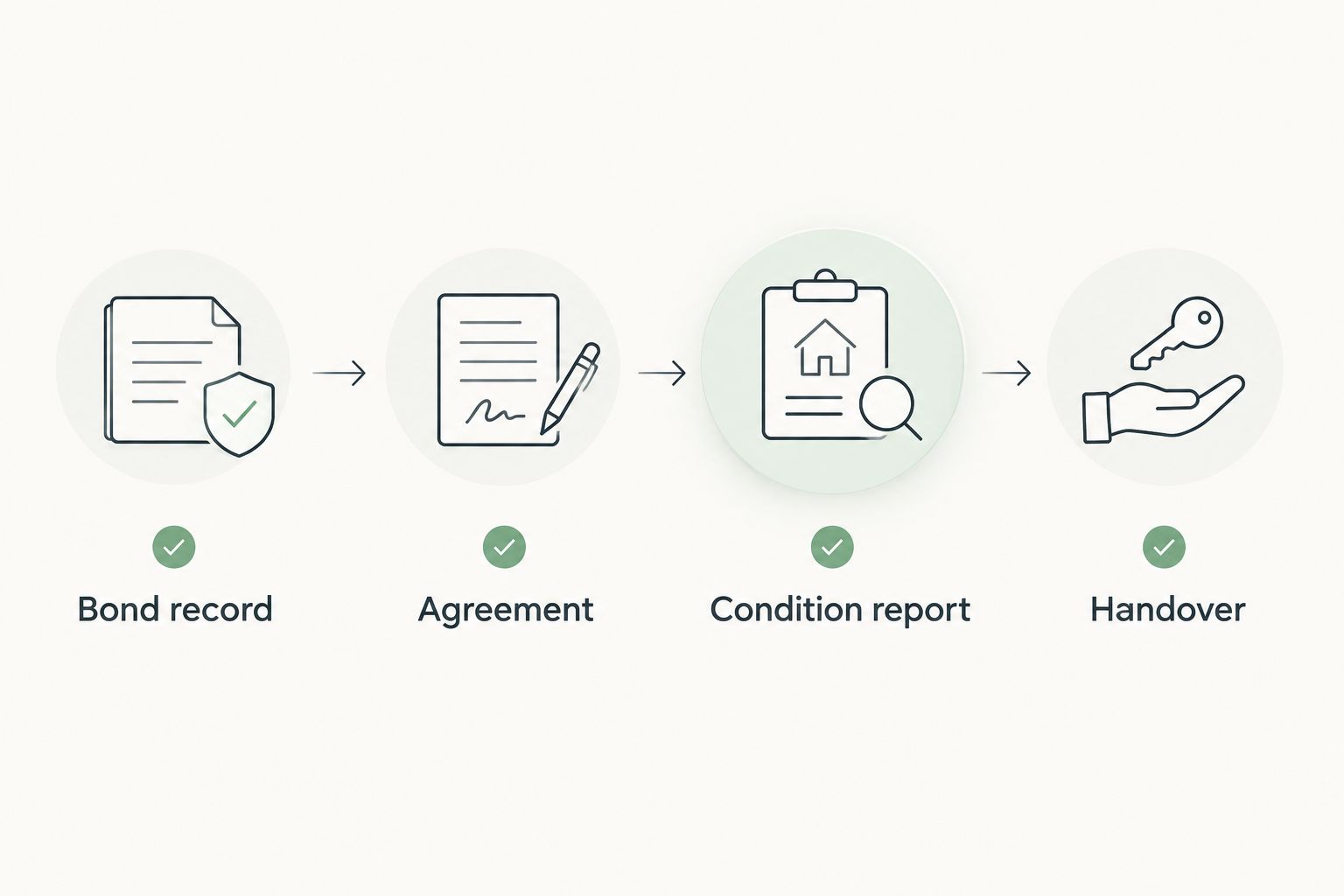
- Create 4 checkpoints. Label them Bond record, Agreement, Condition report and Handover. Under each, record the evidence needed before marking it complete.
- Separate the dates. Add Bond received, Lodgement due, Lodgement confirmed and Tenancy starts. Set the applicable deadline from current CBS requirements, not from an assumed move-in date.
- Set the evidence rule. Require a document, confirmation or dated record behind every completed task. An email saying someone will lodge the bond belongs under pending work, not completed work.
Expected result: You can identify who must act, what evidence is missing and which deadline applies without searching an email chain.
For your 2026 file, keep a dated note of the official guidance used to establish the lodgement deadline. That makes the basis of the checklist clear if another person takes over.
Bond receipt and lodgement record
Treat bond receipt and bond lodgement as separate checks. The first concerns the payment received; the second concerns the bond held through the South Australian system.
- Identify the payment. Match the transaction to the correct tenancy and payer. Record the receipt date and distinguish the bond from rent or another payment rather than treating an unexplained total as sufficient evidence.
- Reconcile the details. Compare the tenant names, property address and bond details with the agreement. Resolve discrepancies before submitting information that would need correction later.
- Complete the applicable lodgement process. Follow the current Residential Bonds Online instructions or the alternative process CBS specifies for your circumstances. Use the official interface instructions rather than relying on an old screenshot or another state's procedure.
- Save the confirmation. Retain the lodgement reference and confirmation in the tenancy file. If the process remains incomplete, record the outstanding action and responsible person instead of marking it lodged.
- Check the tenant's evidence. Confirm that the tenant has the relevant receipt or confirmation information. Investigate missing correspondence rather than assuming that sending an invitation completed the entire process.
Expected result: The tenancy file contains 2 distinct records: evidence of the bond payment and evidence of lodgement. Neither substitutes for the other.
Do not create another lodgement simply because you cannot find the first confirmation. Search the existing record and contact CBS where necessary. Duplicate action creates another reconciliation problem rather than resolving the original one.
Agreement, condition report and handover pack
A bond record does not document the property's starting condition or establish every term of the tenancy. Keep those checks separate so an apparently complete financial file does not conceal an unfinished tenancy file.
- Complete the agreement check. Confirm that the parties, property and commencement details reflect the agreed tenancy. Resolve unsigned sections or inconsistent versions before treating the agreement task as complete.
- Prepare the condition report. Describe the property's condition accurately, including existing damage, cleanliness and relevant fixtures. Use specific observations rather than a blanket description such as good throughout.
- Organise supporting photographs. Group clear images by room or area and retain their dates. Photographs support the written report; they should not leave the reader guessing which defect or location they show.
- Provide the required documents. Supply the agreement, condition report and other information required for the tenancy using the applicable South Australian requirements. Record delivery and explain how the tenant should return condition-report comments.
- Prepare the access record. List the keys, remotes and access devices being handed over. Record the recipient, handover date and any agreed collection arrangements.
- Confirm the start position. Check that the premises and access arrangements match the agreed commencement. Escalate unresolved readiness or document issues rather than allowing the checklist to imply they have disappeared.
Expected result: You have a documented starting position for the tenancy, an identifiable document pack and a clear record of access provided.
The process has four separate checkpoints. Complete each one on its own evidence; do not let a completed bond task automatically close the agreement, condition report or handover tasks.
Variant: when the tenancy start date changes
A changed commencement date needs a controlled update, not a fresh set of disconnected emails. In this 2026 workflow, keep the original receipt history while updating the documents and arrangements affected by the change.
- Record the agreed change. Retain written confirmation of the revised commencement and identify the agreement documents requiring amendment. Do not silently overwrite the only record of the original arrangement.
- Recheck the bond record. Keep the actual bond receipt date. Confirm with CBS how to correct any affected lodged details rather than creating a replacement record without instructions.
- Review property condition. Check whether repairs, cleaning, access or other activity since inspection have changed the condition being documented. Update the report where necessary so it reflects the handover position.
- Reconfirm access and responsibilities. Tell the tenant and relevant service providers which arrangements have changed. Replace superseded handover instructions and identify any outstanding task.
Expected result: The revised start date appears consistently across the current documents, while the payment and decision history remain traceable.
| Workflow | Best for | Advantage | Limitation |
|---|---|---|---|
| Standard tenancy start | An agreed commencement proceeding as planned | Keeps responsibilities and evidence in one sequence | Still requires separate completion checks |
| Revised tenancy start | A commencement date changed by agreement | Identifies documents and arrangements needing updates | Requires version control and renewed checks |
A date change does not mean every document must be recreated. Review what actually changed, preserve the history and correct the affected records.
Troubleshooting
Payment received, but lodgement confirmation is missing
Check the existing bond record, submitted details and outstanding actions in the applicable process. Save the confirmation once resolved. A bank receipt alone is not evidence that lodgement is complete.
Tenant names differ between documents
Compare the agreement and bond record, then establish which details are correct. Follow CBS instructions for correcting a submitted record; do not make an unrelated replacement entry to bypass the discrepancy.
The condition report records the wrong starting condition
Identify the inaccurate description and document the correction, supported by dated photographs where relevant. If work occurred after the inspection, record that change rather than presenting the earlier report as an unchanged handover record.
The owner and agent each assume the other is lodging
Resolve responsibility immediately and check the actual receipt date against the applicable deadline. Record who will complete the lodgement and require confirmation. Keep the responsibility assignment with the management instructions.
Keys are ready, but documents remain unresolved
List the unresolved items and obtain instructions from the responsible property manager or appropriate adviser. Do not invent a right to delay access: unresolved administration and the parties' legal rights require separate consideration.
Customise your workflow
Keep the checklist independent of whoever currently manages the property. A named owner can change; the evidence requirements should remain visible. This matters when a landlord appoints an agent during tenancy preparation.
If you are transferring responsibility, use the self-managed rental to property management workflow alongside this checklist. Transfer the existing bond record, agreement versions and outstanding tasks rather than treating the appointment as a new tenancy.
Axiom Realty offers property management to South Australian property investors. Agency management provides an alternative to personally coordinating the process, but it does not remove the need to define instructions, responsibilities and records.
For multiple properties, keep a separate checklist for every tenancy. Add a portfolio summary showing only exceptions: unconfirmed lodgements, incomplete documents and unresolved handovers. Keep identity documents and detailed tenant information in appropriately restricted files rather than copying them into a widely shared summary.
FAQ
What does rental bond lodgement to tenancy start involve in South Australia?
It involves checking bond receipt and lodgement, completing tenancy documents, recording property condition and documenting handover. Keep separate evidence for each task rather than treating payment as completion of the whole process.
Is paying the rental bond the same as lodging it?
No. Payment records show that money was transferred, while lodgement confirmation records the bond's lodgement through the applicable South Australian process. Retain both records.
Who should lodge the bond, the landlord or property manager?
Assign responsibility according to who receives the bond and the applicable South Australian requirements. Where an agent is appointed, record the responsibility explicitly and retain confirmation that the task is complete.
Does a later move-in date reset the bond receipt date?
No. A revised commencement date does not change when the bond was actually received. Preserve the receipt date and check the applicable lodgement obligation separately.
What should I do if the bond confirmation has not arrived?
Check the existing record and any outstanding actions before submitting anything again. Contact CBS if necessary to establish the record's status and avoid creating a duplicate lodgement.
Do photographs replace the entry condition report?
No. Use photographs to support an accurate written condition report, not to replace it. Organise images by room or area so the condition being recorded is clear.
Can Axiom Realty help with South Australian property management?
Axiom Realty offers property management services to South Australian property investors. Confirm the proposed responsibilities and service arrangements directly before appointing the agency.
One last thing
A key handover record is not proof that the bond was lodged, and a lodged bond is not proof that the condition report was completed. Before closing your 2026 tenancy-start checklist, open the evidence behind each completion mark. That final check tests the records rather than the appearance of progress.