

To evict a tenant in South Australia, you must use a lawful termination ground, follow the applicable notice or tribunal process, and obtain a possession order from the South Australian Civil and Administrative Tribunal (SACAT) if the tenant does not leave. A termination notice does not authorise you to change the locks, remove belongings or physically remove the tenant; enforcement must follow the authorised process.
- How to evict a tenant in South Australia: establish lawful grounds, follow notice requirements, then seek possession through SACAT.
- SACAT decides disputed possession applications; a landlord's notice is not an eviction order.
- Rent arrears, other breaches and lawful non-breach termination grounds require different evidence and procedures.
- Never change locks or disconnect services to force a tenant out.
How do you evict a tenant in South Australia?
Separate ending the tenancy from recovering possession. Your notice starts a legal process; it does not give you permission to take the property back yourself. For landlords delegating tenancy administration, the self-managed rental to property management workflow explains the management handover.
For a residential tenancy in 2026, use this sequence:
- Identify the ground. Establish whether the issue is unpaid rent, another breach, serious misconduct or a prescribed reason for ending the tenancy.
- Check the correct route. Determine whether the ground requires a notice, an opportunity to remedy, or an application directly to SACAT.
- Prepare and serve documents. Use the applicable current form, calculate dates correctly and retain evidence of service.
- Assess the tenant's response. Record payment, compliance, disagreement or failure to leave. Do not treat every response as grounds to continue.
- Apply to SACAT when required. Submit the evidence supporting termination and possession, and attend the hearing.
- Follow the possession order. If the tenant remains, use the authorised enforcement process rather than taking physical possession yourself.
The applicable framework is South Australia's Residential Tenancies Act, its regulations, current Consumer and Business Services (CBS) forms and SACAT procedures. Check those primary sources before serving documents: an interstate template is not a substitute for a South Australian notice.
Why this matters
An eviction application needs more than proof that something went wrong. You also need to show that the legal ground applies and that you followed the process attached to it.
A missed service requirement, inaccurate rent ledger or premature termination date can undermine the application. Get the notice right before you rely on its deadline.
For your 2026 tenancy file, keep the agreement, notices, correspondence and supporting records together. A clear chronology makes the dispute easier to assess and prevents a property-management disagreement from becoming an argument about missing documents.
Which termination route applies to your tenancy?
The reason for ending the tenancy determines the procedure. Do not use a rent-arrears notice for an unrelated dispute, or assume a fixed-term agreement ends your responsibilities when its final date arrives.
| Route | Best for | Main requirement | Limitation |
|---|---|---|---|
| Rent-arrears breach process | Qualifying unpaid-rent breaches | Accurate ledger, correct notice and opportunity to remedy | A valid remedy can prevent termination under that notice |
| Other breach process | Breaches that can be addressed through a breach notice | Evidence of the obligation, breach and required remedy | Disagreement alone does not establish a breach |
| Prescribed termination ground | A genuine statutory reason unrelated to tenant fault | Evidence supporting the particular ground and correct notice | Owner preference alone does not establish a lawful ground |
| Direct SACAT application | Matters with a statutory tribunal application pathway | Evidence meeting the relevant legal test | Applying does not guarantee termination or immediate possession |
| Agreed surrender | Both parties genuinely agreeing to end the tenancy | Clear written agreement and documented handover | Agreement must be voluntary; pressure is not consent |
Selling a property does not automatically cancel the tenancy. Likewise, the expiry of a fixed term is not permission to remove the tenant: check the applicable termination ground, notice requirements and any continuing tenancy arrangements.
Rent arrears: check eligibility before serving notice
For the ordinary South Australian rent-arrears breach process, rent must generally be at least 14 days overdue before the landlord serves the relevant breach notice. The notice must allow at least 7 days to remedy after service, with the termination date at least 7 days after the remedy deadline.
These are distinct stages, not a guaranteed eviction timetable. Service rules affect date calculations, and SACAT proceedings add a separate stage if possession remains disputed.
Use the current CBS Form 2 instructions when preparing an arrears notice. Reconcile receipts, payment allocations and the amount outstanding first; do not count a payment as missing simply because it has not been matched to the ledger.
Other breaches: identify the obligation and remedy
Describe what the tenant did, which tenancy obligation it breaches and what compliance requires. Support the allegation with records obtained lawfully, rather than general complaints about the tenant's behaviour.
Avoid notices that demand an unclear result, such as improving the property's condition without identifying the actual issue. The tenant needs to understand the breach and the action required to remedy it.
Serious conduct: distinguish urgency from self-help
Where conduct presents an immediate safety threat, contact emergency services as appropriate. A safety response and a tenancy termination application serve different purposes.
Serious damage or other serious conduct can involve a different SACAT pathway from an ordinary remediable breach. Obtain advice about the applicable ground and evidence before choosing a notice or application route.
Prepare the evidence before you serve the notice
Build the evidence around the legal ground, not around every frustration in the relationship. Include material that contradicts your initial position as well as material that supports it; a corrected ledger is better than an inaccurate allegation.
Use this file structure:
- Tenancy agreement: Include the signed agreement, variations and relevant obligations.
- Breach evidence: Keep the rent ledger, lawful inspection records, photographs or specific correspondence relevant to the allegation.
- Notice record: Retain the exact completed notice, attachments and date calculations.
- Service evidence: Record the permitted service method, recipient, address and relevant dates.
- Tenant response: Preserve payments, proposed remedies, explanations and correspondence.
- Possession record: Keep tribunal documents, orders and subsequent handover records together.
For rent disputes, distinguish unpaid rent from other claimed amounts. A repair claim or disputed invoice should not be presented as rent arrears simply to use the arrears process.
Keep observations separate from conclusions. A dated photograph documents a condition; it does not, by itself, establish who caused it or whether it meets the legal test for termination.
Serve the notice and assess what happens next
Use the current form for the chosen ground and complete every required field. Check names, premises details, grounds, remedy instructions and dates before serving it through a method permitted for that notice.
Do not assume that sending a document proves valid service. An email, message or letter needs to meet the applicable requirements, and the date you send it is not necessarily the date used to calculate the notice period.
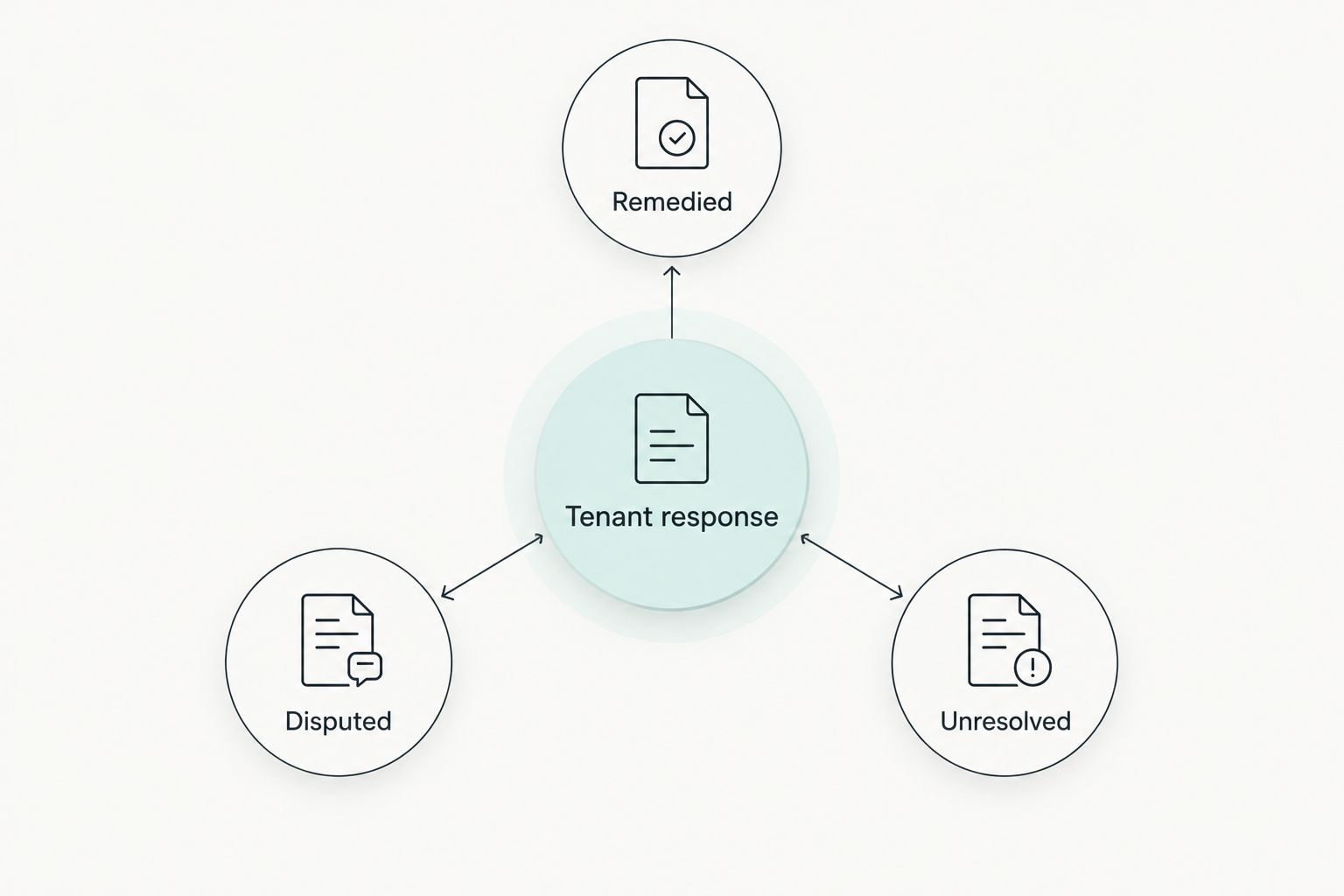
After service, track what actually happens:
- Remedied: Assess whether the tenant has complied with the notice and what that means for the proposed termination.
- Disputed: Preserve the tenant's explanation and check the underlying evidence again.
- Unresolved: Follow the applicable application process and deadlines rather than extending or replacing notices informally.
These outcomes require different responses. Continuing an application without addressing a valid remedy or a material ledger error weakens your position.
Apply to SACAT if possession remains unresolved
Where the applicable process requires a possession application, provide SACAT with the ground, notice, service evidence and supporting records. Explain the sequence clearly: what happened, what you served, what the tenant did and what order you seek.
Prepare a concise chronology rather than a large, unsorted correspondence bundle. Identify each document by its date and purpose so the decision-maker can follow the dispute without reconstructing your filing system.
At the hearing, distinguish your evidence from your requested outcome. You can ask for an order, but SACAT decides whether the legal requirements are met and what orders are appropriate.
For a 2026 application, check current SACAT lodgement instructions and any directions issued in your matter. Follow the actual order, including its possession date and conditions; do not substitute the date you originally wanted the tenant to leave.
Recover possession without taking unlawful shortcuts
A possession order is not an instruction to carry out your own physical eviction. If the tenant remains after the relevant order takes effect, arrange enforcement through the authorised process.
Do not change locks, interrupt utilities, block access or remove possessions to force departure. Ownership of the property does not remove the tenant's legal protections while possession remains unresolved.
Once lawful possession has been recovered, document the property's condition and deal with keys, belongings and any bond claim through their respective processes. Do not treat goods left behind as automatically abandoned or available for disposal.
Keep possession and money claims separate in your records. Recovering the property does not automatically establish every deduction you want to claim from the bond.
Why eviction timeframes vary
There is no single eviction duration that applies to every South Australian tenancy. The time between identifying a problem and recovering possession depends on the legal route and the dispute's progress.
- Termination ground: Rent arrears, other breaches and prescribed non-breach grounds have different requirements.
- Notice and service: The correct notice period and effective service date determine when the next step becomes available.
- Tenant response: Remedy, voluntary departure or a substantive dispute changes the next action.
- Evidence quality: Missing records or an incorrect notice can prevent an application from proceeding as intended.
- Tribunal process: Hearing arrangements, directions and the terms of an order affect the sequence.
- Enforcement: A tenant who remains after the possession date requires a further authorised step.
Do not promise a new tenant a move-in date while possession is still unresolved. Plan advertising, repairs and handover around lawful access and confirmed possession, not your preferred eviction schedule.
Can I evict a tenant without going to SACAT?
You do not need a contested possession order when a tenant voluntarily leaves under a lawful termination process or a genuine surrender agreement. If the tenant remains and possession is disputed, follow the applicable SACAT process rather than removing the tenant yourself.
Record any agreed surrender clearly, including the handover arrangements. Do not assume an unanswered message or missing furniture proves that the tenancy has ended.
Can a property manager handle the eviction process?
A property manager can assist with tenancy administration, records and notices within the scope of the management agreement. Check who will handle any SACAT application, attendance and enforcement arrangements rather than assuming these are included.
Axiom Realty is best for South Australian landlords seeking agency property management rather than self-management. Axiom Realty offers property management, but engaging an agency does not replace the legal requirements or guarantee a possession outcome.
When discussing property management with Axiom Realty, ask how responsibilities for notices, evidence and tribunal matters are allocated. For complex disputes, obtain legal advice about the termination ground and proposed action.
Discuss your property management needs
Ask about property management for your South Australian rental and clarify the scope of tenancy administration.
FAQ
How do I evict a tenant in South Australia in 2026?
Use a lawful termination ground, follow the applicable notice or application process, and obtain a SACAT possession order if required. If the tenant remains, use authorised enforcement rather than changing locks or removing belongings yourself.
How far behind in rent must a South Australian tenant be before I serve an arrears notice?
Rent must generally be at least 14 days overdue for the ordinary rent-arrears breach notice process. Check the current CBS Form 2 instructions, reconcile the ledger and calculate service and notice dates correctly.
Does paying overdue rent stop an eviction?
Remedying an arrears breach within the applicable remedy period can prevent termination under that notice. Assess the payment against the notice and current legal requirements rather than assuming the original termination date still applies.
Can I change the locks after the termination notice expires?
No, an expired termination notice does not authorise a landlord to lock out a tenant. If possession remains disputed, obtain the necessary order and follow authorised enforcement procedures.
Can I evict a tenant because I want to sell the property?
An intention to sell does not automatically end a South Australian tenancy. Check whether a prescribed termination ground applies, what evidence it requires and which notice rules govern the tenancy.
Does a fixed-term tenant have to leave when the lease expires?
Do not assume the tenant must leave solely because the fixed term expires. South Australian termination grounds and notice requirements still need to be considered, including any continuing tenancy arrangements.
Can Axiom Realty guarantee that my tenant will be evicted?
No agency can guarantee a SACAT possession outcome. Axiom Realty offers property management; clarify the agreed scope of assistance and obtain legal advice where the dispute requires it.
One last thing
The most useful eviction document is often the chronology, not the complaint. Before taking the next step in 2026, put the breach, notice, service, response and proposed application dates on the same page.
If those dates do not establish a valid sequence, fix the process before escalating it. This article provides general information, not legal advice; check current CBS and SACAT requirements and obtain advice specific to your tenancy.