

Yes, you can self-manage your rental property in Adelaide in 2026; you do not have to appoint a real estate agent to manage a property you own. You take responsibility for tenancy paperwork, bond lodgement, repairs, rent records, lawful access and disputes, so avoiding agency management fees does not remove the work or your legal obligations.
- Can I self manage my rental property in Adelaide? Yes—South Australian tenancy obligations still apply.
- Self-management suits landlords who can handle tenant communication, repairs, records and compliance themselves.
- Axiom Realty offers Adelaide property management for landlords who prefer to appoint an agency.
- Choose your management approach around your availability and responsibilities, not management fees alone.
Can I self-manage my rental property in Adelaide?
Yes. Owning the property allows you to manage it yourself, but it does not exempt you from South Australian residential tenancy law. Your tenant retains the same rights whether you appoint an agent or deal with them directly.
The practical choice is who performs the work. If you later appoint an agency, the self-managed rental to property management workflow explains the handover process.
| Management approach | Best for | Main advantage | Main drawback |
|---|---|---|---|
| Self-management | Owners able to handle administration, tenant contact and maintenance coordination | Direct oversight of decisions and communication | You must organise the work and maintain compliant processes |
| Agency management | Owners who want an appointed agent handling the agreed management tasks | A defined point of responsibility for day-to-day administration | Management fees apply, and you still need to oversee major decisions |
Neither approach removes your responsibility to maintain the property. An agent manages within the authority you give them; ownership obligations do not disappear when you sign a management agreement.
Why this matters
A rental can feel straightforward while rent arrives and nothing breaks. The real test comes when a repair is urgent, a payment is missed or a tenant disputes your account of the property's condition.
Choose the approach you can sustain during a difficult tenancy, not just a quiet one. A friendly relationship helps communication, but written records and lawful procedures protect both parties when memories differ.
For a 2026 tenancy, use Consumer and Business Services South Australia as your starting point for residential tenancy requirements. Check current official guidance before serving notices or acting on an older template; this article provides general information, not advice on an individual dispute.
What does a self-managing Adelaide landlord need to do?
Self-management covers the whole tenancy, not just collecting rent. Set up the following process before you advertise or take over an existing lease.
Establish the tenancy
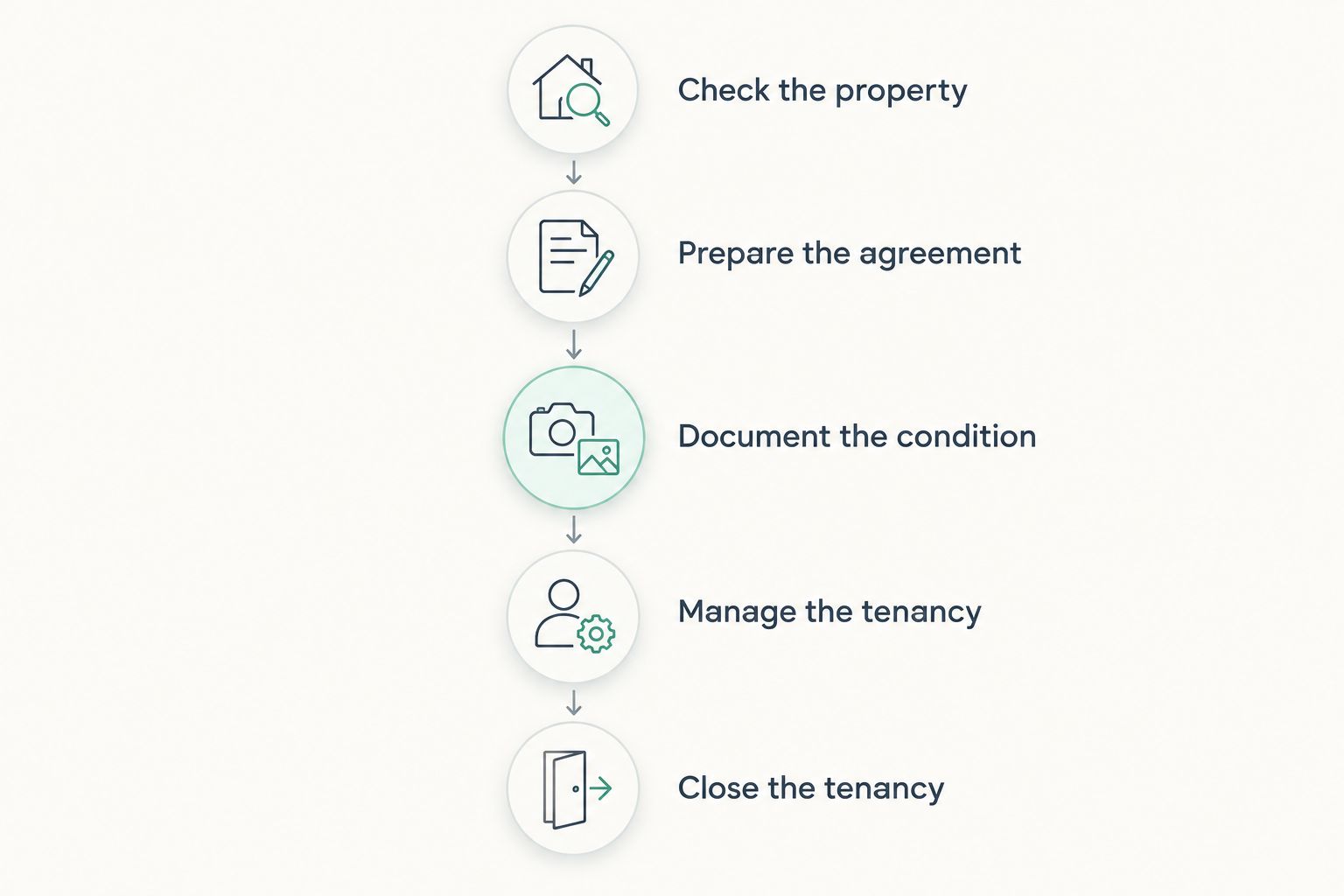
- Check the property. Identify outstanding repairs, safety issues and applicable minimum housing requirements. Arrange qualified trades where the work requires them.
- Prepare the agreement. Use documentation appropriate to a South Australian residential tenancy. Record the parties, property, tenancy terms and agreed arrangements clearly.
- Document the condition. Complete the required inspection documentation and take clear, dated photographs. Give the tenant the opportunity required by the applicable process to record their observations.
- Handle the bond correctly. Follow the official bond lodgement process rather than treating the bond as money available for maintenance or cash flow.
- Set up communication. Give the tenant clear contact details, a way to report maintenance and instructions for urgent problems.
For private landlords, South Australian bond guidance requires lodgement within 14 days of receiving the bond. Consumer and Business Services explains the lodgement process through Residential Bonds Online; verify the current requirements when you receive payment.
Do not leave documentation until after the tenant moves in. An incomplete starting record makes it harder to distinguish an existing defect from damage alleged at the end of the tenancy.
Manage the occupied property
- Keep a rent ledger. Record amounts received, payment dates and the rental period covered. Reconcile the ledger against your bank records instead of relying on payment notifications.
- Coordinate repairs. Record the issue, arrange the appropriate response and retain the tenant's messages, work orders and invoices. Keep urgent repair communication separate from routine administrative requests.
- Inspect lawfully. Use the correct grounds, notice and frequency for entry. Ownership does not give you unrestricted access to an occupied rental.
- Review changes formally. Check the rules before changing rent, tenancy terms or other arrangements. A conversation is not a substitute for a required notice.
- Close the tenancy properly. Follow the applicable termination, final inspection and bond process. Separate documented damage claims from ordinary wear and tear.
Your records should allow someone else to understand what happened without you explaining every message. That becomes especially useful if you appoint an agent or need to present evidence in a dispute.
Self-management: best for owners with time and a working process
Self-management gives you direct contact with your tenant and control over how you organise the work. You decide which trades to engage, maintain your own records and handle enquiries without an agency acting between you and the tenant.
The drawback is that every unresolved task remains yours. If you are away, unwell or unavailable during work hours, you still need an arrangement for maintenance requests and other tenancy issues.
Before choosing self-management, ask yourself:
- Can you respond to an urgent problem while travelling or working?
- Can you distinguish a routine request from an issue needing immediate action?
- Can you keep a complete ledger and retrieve documents when needed?
- Can you follow the legal process even when a tenant is upset or uncooperative?
- Can you arrange reliable help when you cannot attend personally?
Self-manage only if you can provide the administration as well as the attention. Being handy with repairs does not replace knowing when a notice is required or how to document a payment dispute.
Agency management: best for owners who want to delegate
An agency can handle the tasks specified in its management agreement, including agreed tenant communication, administration and maintenance coordination. Read the agreement to understand the scope rather than assuming every property-related task is included.
Axiom Realty's property management is best suited to Adelaide landlords seeking agency management rather than handling the tenancy themselves. The agency provides property management in South Australia; confirm the proposed responsibilities, authority and reporting arrangements before appointing it.
The trade-off is straightforward: you pay for management and still retain decisions that fall outside the agent's authority. Ask how expenditure approvals, urgent repairs, inspection reporting and unresolved tenant issues will be handled.
An appointment also needs a clean handover. Supply the lease, bond details, ledger, condition records, keys and outstanding maintenance history so the incoming manager starts with an accurate account.
Why the self-management workload varies
There is no useful single workload estimate for every Adelaide rental. The responsibilities stay in place, but the amount of coordination depends on the property and the tenancy.
Assess these factors when making your 2026 management plan:
- Property condition: Outstanding repairs create work that remains outstanding regardless of who manages the rental.
- Your location: Distance changes how you arrange access, inspections and attendance when something needs checking.
- Tenant turnover: Advertising, enquiries, applications, agreements and condition documentation return whenever a tenancy changes.
- Maintenance arrangements: A clear repair reporting process and suitable trades make coordination more organised.
- Record quality: Missing agreements, incomplete ledgers and scattered messages make later decisions harder to support.
- Your availability: Work commitments, holidays and illness need a backup arrangement rather than an unanswered phone.
An interstate owner needs local arrangements even when the tenancy is otherwise uncomplicated. The interstate landlord to local property management workflow sets out the handover considerations if distance makes direct management impractical.
Can I inspect my Adelaide rental whenever I want?
No. For routine inspections in South Australia, the general limit is 4 inspections in a 12-month period, with 7–14 days' written notice before entry. Consumer and Business Services' residential tenancy entry guidance sets out the requirements and separate grounds for other types of access.
Treat those figures as inspection rules, not permission to use routine inspections for another purpose. Urgent repairs, agreed access and other lawful reasons for entry have their own conditions.
For inspections arranged in 2026, check the current official entry requirements and use an appropriate notice. Keep a copy of what you sent, how you served it and the inspection record.
Do not arrive unannounced because you own the property. Where access is disputed, establish the correct process before escalating the disagreement.
Can I self-manage if I live outside Adelaide?
Yes, but you need a practical way to arrange lawful access, repairs and local attendance. Email and online records help you administer a tenancy; they do not inspect a leak or let a tradesperson into a property.
Write down who handles an urgent issue when you cannot attend. Check that the person has agreed to help, understands their role and can obtain the necessary information without searching your messages.
If that arrangement depends on a friend always being available, examine the gap before a problem occurs. Distance is manageable only when someone can perform the physical tasks the tenancy requires.
Can I switch from self-management during a tenancy?
Yes, you can appoint a property manager during an existing tenancy. The appointment changes who performs the management work; it does not automatically replace the tenant's existing agreement or remove accrued obligations.
Prepare a handover pack containing:
- The signed tenancy agreement and subsequent written changes.
- Bond records and an up-to-date rent ledger.
- Initial condition documentation, photographs and inspection reports.
- Notices, unresolved requests and relevant correspondence.
- Keys, access details and current contractor information.
Tell the tenant clearly who will manage the property and how to verify any new payment instructions. Confirm the effective handover date so maintenance reports and rent payments do not fall between two sets of arrangements.
How should I decide before taking on the work?
Run a practical readiness check rather than deciding on fees alone. Open a sample tenant file and work through an unpaid rent query, a repair report and a proposed inspection: identify the record, action and official guidance you would need for each.
Then check your backup arrangements. If you cannot explain who responds during your absence, or where the lease and ledger are stored, fix the process before taking responsibility for an occupied property.
Axiom Realty offers Adelaide property management alongside its other real estate services. If you prefer delegation, ask for a written explanation of the management scope and your remaining responsibilities, then compare that with the tasks you are prepared to perform yourself.
FAQ
Do I need a real estate licence to manage my own Adelaide rental?
You do not need to appoint a licensed agent simply to manage a rental property you own. Managing property for other owners is a different activity with separate licensing considerations.
How quickly do I need to lodge my tenant's bond?
Private landlords in South Australia must lodge the bond within 14 days of receiving it. Check Consumer and Business Services guidance for the current lodgement procedure and required details.
How often can I inspect my rental property in Adelaide?
Routine inspections are generally limited to 4 inspections in a 12-month period, with 7–14 days' written notice. Other grounds for entry have separate requirements, so check the rule that applies to your situation.
Can I self-manage my rental property in Adelaide while living interstate?
Yes, you can self-manage from interstate, but you still need arrangements for local access, repairs and attendance. Distance does not reduce your obligations to the tenant.
Does appointing a property manager remove my landlord responsibilities?
No, appointing a property manager does not remove your obligations as the property owner. The management agreement defines the tasks and authority you delegate to the agent.
Can I appoint a property manager without ending the lease?
Yes, you can appoint a property manager during an existing tenancy without ending the lease. Provide complete records and clearly communicate the change in management and verified payment arrangements.
Where should I check South Australian tenancy rules in 2026?
Use Consumer and Business Services South Australia for current residential tenancy guidance in 2026. For a disputed notice, termination or bond claim, obtain advice specific to the circumstances before acting.
One last thing
Before you self-manage in 2026, create a tenancy handover file—even if you do not intend to appoint an agent. Keep the agreement, ledger, bond record, condition evidence and open maintenance items together, with access arranged for a trusted backup.
The test is simple: could someone understand the tenancy if you were unavailable? If the answer is no, improve the records before relying on your memory.