

Commercial property management is worth it for Adelaide investors when the work delegated, lease administration and oversight justify the management agreement’s obligations. Self-management remains a reasonable choice when you understand the lease, can respond to problems and have time to keep accurate records. Judge the service by its written responsibilities and reporting—not by the promise of a hands-off investment.
- Is commercial property management worth it? Adelaide investors should compare delegated responsibilities, lease complexity and their own capacity.
- Professional management suits owners who need documented oversight of rent collection, maintenance and lease deadlines.
- Self-management suits owners with the time, lease knowledge and systems to carry out the work.
- Axiom Realty offers property management and investment advisory; confirm commercial-property scope before appointing the agency.
Why this matters
A commercial property investment needs more than rent collection. Someone must track the lease, check accounts, arrange authorised work and keep decisions moving when the tenant raises an issue.
For your 2026 review, separate investment decisions from administrative work. You can delegate day-to-day tasks without giving up control over major expenditure, leasing strategy or whether to sell.
Axiom Realty offers property management and investment advisory to South Australian investors. That combination suits owners seeking both services from one agency; commercial management experience and the proposed appointment still need checking against your property.
Is commercial property management worth it for Adelaide investors?
Commercial property management is worth considering when you need a clearly accountable person to administer the lease and coordinate the property. It is less compelling when the appointment leaves important tasks with you or duplicates work you already handle effectively.
Compare these arrangements against the actual work your property requires. None removes the owner’s need to make decisions.
| Arrangement | Best for | Main advantage | Main drawback |
|---|---|---|---|
| Professional management | Owners who need ongoing administration and coordination | Allocates agreed tasks to a manager and creates a reporting relationship | Adds an ongoing expense and requires oversight of the manager |
| Self-management | Owners with time, lease knowledge and reliable records | Keeps direct control over communications and decisions | Leaves administration, follow-up and coordination with the owner |
| Defined task delegation | Owners who can manage routine work but need specific help | Directs outside help towards an identified gap | Creates handover risks unless responsibilities are explicit |
The strongest appointment closes a real operational gap. A manager who takes responsibility for lease dates, account reconciliation and maintenance follow-up performs a different role from someone engaged only to collect rent.
Before deciding, write down what you currently do and what remains undone. Compare that list with the proposed management agreement, including exclusions and matters requiring your approval.
Professional management: best for owners needing ongoing oversight
Professional management fits an owner who cannot consistently handle tenant communication, accounts and property coordination. Distance matters, but so does availability: living in Adelaide does not help if you cannot respond during your working day.
Ask for a written scope covering the tasks relevant to your lease:
- Rent collection, payment allocation and arrears reporting.
- Lease-date tracking, including reviews, expiries and notice requirements.
- Maintenance requests, owner approvals and contractor coordination.
- Outgoings administration where the lease and applicable law permit recovery.
- Owner statements, supporting records and unresolved-issue reporting.
These are assessment criteria, not a statement that every management appointment includes them. Check who performs each task and how you receive evidence of completion.
The benefit is defined responsibility; the limitation is that you must still supervise the appointment. You remain responsible for understanding what authority you have granted and making decisions reserved for you.
Self-management: best for capable, available owners
Self-management fits owners who can read and administer their commercial lease, maintain records and respond consistently. Direct tenant contact can make communication straightforward, provided agreements and decisions are documented.
The drawback is workload that does not disappear when business or personal commitments become inconvenient. A maintenance request still needs assessment, an unpaid account still needs follow-up, and a lease deadline still needs attention.
Use a practical test: can someone else understand the property’s position from your records without asking you to reconstruct events? If not, improve the records before treating self-management as an efficient arrangement.
For 2026, assess your capacity as it exists now—not the spare time you expect to have later. Self-management is a working role, not simply the absence of a manager.
Defined task delegation: best for owners with a specific gap
You do not have to treat the decision as all-or-nothing. An owner who handles routine administration can seek separate assistance with leasing, legal interpretation, accounting or a particular property issue.
The advantage is a narrower appointment directed at a known need. The disadvantage is coordination: separate advisers do not automatically share records or monitor one another’s deadlines.
Write down who owns each task, who receives the result and who acts next. For example, obtaining legal advice about a lease provision does not itself allocate responsibility for sending a notice or updating the lease diary.
Choose limited delegation only when the boundary between your work and the adviser’s work is clear. Otherwise, a task can remain unfinished while everyone assumes someone else is handling it.
Why the value of commercial property management varies
The value depends on the property’s workload and your ability to carry it—not on the Adelaide address alone. Use these factors to assess your own situation rather than applying a blanket rule.
- Lease administration: Review provisions, options, notice requirements and other obligations create work that needs an accurate diary and supporting documents.
- Tenant communication: Unresolved queries, payment follow-up and requests for consent require a clear contact and documented responses.
- Property coordination: Maintenance and access arrangements need someone to assess requests, obtain authority and track completion.
- Owner capacity: Your location, availability and knowledge determine how much work you can reliably retain.
- Appointment scope: A narrow rent-collection service does not provide the same responsibilities as a broader management appointment.
A simple property can still be difficult to self-manage when you are unavailable. Equally, appointing a manager does not resolve an unclear lease or fund necessary repairs.
How do you decide whether to appoint a commercial property manager?
Use a written process before signing a management agreement. The aim is to match an identified workload with a person who accepts responsibility for it.
- List responsibilities. Record rent administration, lease dates, accounts, maintenance and tenant communication. Mark the tasks you already complete reliably.
- Check the lease. Have unclear provisions assessed by an appropriately qualified adviser. Identify the obligations the proposed manager will need to administer.
- Match the scope. Compare your task list with the appointment. Ask about exclusions, approval requirements and separately arranged services.
- Set reporting. Agree how you will see completed work, outstanding issues and decisions awaiting your instruction.
- Review performance. Use the agreed scope to assess delivery, rather than relying on whether the relationship feels quiet.
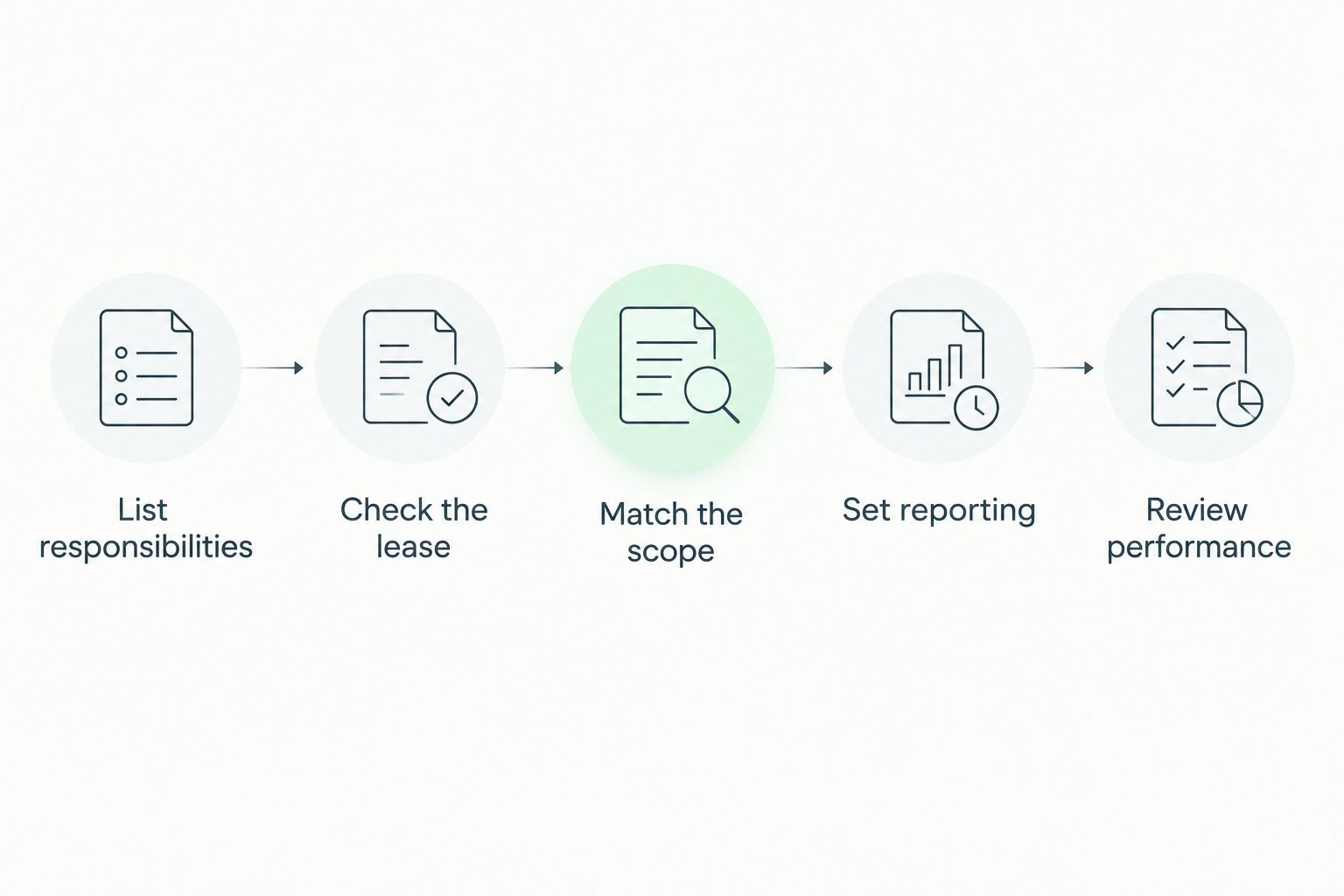
Keep the completed checklist with your management agreement. It gives you a practical reference when a task is missed or a disagreement arises about who was meant to act.
What should you ask before signing?
Ask who will manage the property, what relevant commercial experience they have and how responsibilities are covered during absences. Request an explanation of the reporting format and the process for escalating unresolved matters.
For a 2026 appointment, ask the manager to explain how they would administer your actual lease. A general service description is not a substitute for identifying your review dates, approval boundaries and reporting needs.
Have the agreement’s termination provisions and authority limits explained before you sign. An appointment should make it clear both how the relationship operates and how it ends.
Can a commercial property manager improve your investment return?
A commercial property manager can support the administration behind your return, but an appointment does not guarantee higher income or a better investment result. Collection, reconciliation and maintenance coordination are management activities; market demand and the lease also affect the outcome.
Separate the manager’s work from factors outside the appointment. A completed rent review process is evidence of administration, while the result depends on the lease mechanism and relevant circumstances.
Judge proposed improvements by the action behind them. Ask what will change, who will carry it out and how you will verify completion. Do not treat an income promise as a substitute for a defined service.
Do you still need a solicitor and accountant?
A commercial property manager does not replace a solicitor or accountant. Use a solicitor for legal advice and an accountant for tax and accounting advice relevant to your ownership arrangements.
Your manager can coordinate information within the agreed scope, but coordination is different from professional advice. Keep the final advice and any resulting instructions with the property records.
This distinction also helps prevent gaps. When advice requires action, allocate that action explicitly rather than assuming the adviser or manager will complete it automatically.
How should you review a commercial property manager’s performance?
Review performance against the agreement and the property’s records. For your 2026 assessment, ask whether reports reconcile, outstanding issues have an owner, and upcoming lease events are visible early enough for you to decide what to do.
Use evidence rather than impressions:
- Compare owner statements with supporting account records.
- Check that maintenance requests show their status and approval history.
- Confirm that lease events are recorded and assigned for action.
- Review unresolved matters and the next required step.
A quiet reporting period is not proof of good management. It can mean there were no issues, but it can also mean the reporting does not show them; ask for enough detail to distinguish the two.
FAQ
Is commercial property management worth it for an Adelaide investor with one property?
Commercial property management can be worthwhile for an Adelaide investor with one property when the lease workload exceeds the owner’s time or knowledge. Assess responsibilities and availability rather than deciding from the property count alone.
Can I manage my own commercial investment property in Adelaide?
Self-management is an option to assess if you can administer the lease, maintain records and respond to property issues. Confirm the legal requirements applying to your circumstances and obtain advice where your responsibilities are unclear.
Does a commercial property manager handle all repairs?
A commercial property manager handles repair coordination only to the extent authorised by the appointment. Responsibility for the work and its expense also depends on the lease and applicable law.
Is a commercial property manager responsible for finding tenants?
Finding tenants is not automatically included in every commercial management appointment. Confirm whether leasing work is included, separately arranged or outside the proposed scope.
What should I check before changing commercial property managers?
Check the current agreement’s termination requirements and arrange the transfer of lease documents, financial records, keys and outstanding matters. Confirm who remains responsible during the handover.
Can I ask Axiom Realty about managing an Adelaide investment?
Axiom Realty offers property management and investment advisory for South Australian investors. For a commercial investment, ask the agency to confirm relevant experience, the available service scope and the proposed responsibilities.
Will commercial property management make my investment passive?
Commercial property management does not remove your role as owner. You still need to review reports, provide instructions and make decisions outside the manager’s authority.
One last thing
Before appointing a manager, ask for a written explanation of what they will not do. Exclusions reveal where your workload remains and where another adviser is needed.
Make that exclusions list part of your 2026 decision. A clearly limited appointment is easier to supervise than a broad promise with unclear boundaries.