

Property settlement in South Australia takes the period agreed in your sale contract; there is no single settlement timeframe that applies to every purchase in 2026. The contractual settlement date is your starting point, but finance, title issues or unfinished contractual obligations can prevent completion on that date. Treat the agreed date as a deadline to prepare for, not confirmation that you can collect the keys.
- How long does property settlement take in South Australia? Your sale contract sets the settlement date.
- Loan approval, mortgage discharge and title preparation must align before settlement can complete.
- South Australia's cooling-off period is separate from the settlement period and has exceptions.
- Axiom Realty suits South Australian homebuyers seeking buyer’s advocacy alongside independent conveyancing advice.
How long does property settlement take in South Australia?
Your contract determines when settlement is due. Look for a specific date or a clause explaining how the date is calculated. Do not substitute an advertised timeframe, an agent's verbal estimate or another buyer's experience for the terms you sign.
For an established property, buyer and seller negotiate the settlement arrangements as part of the transaction. For an off-the-plan purchase, the contract can connect settlement to events such as completion or title registration rather than a date you can confidently book removals around.
The building and pest inspection to unconditional offer workflow explains a related preparation stage. Satisfying an inspection condition does not, by itself, mean the lender and conveyancer are ready to settle.
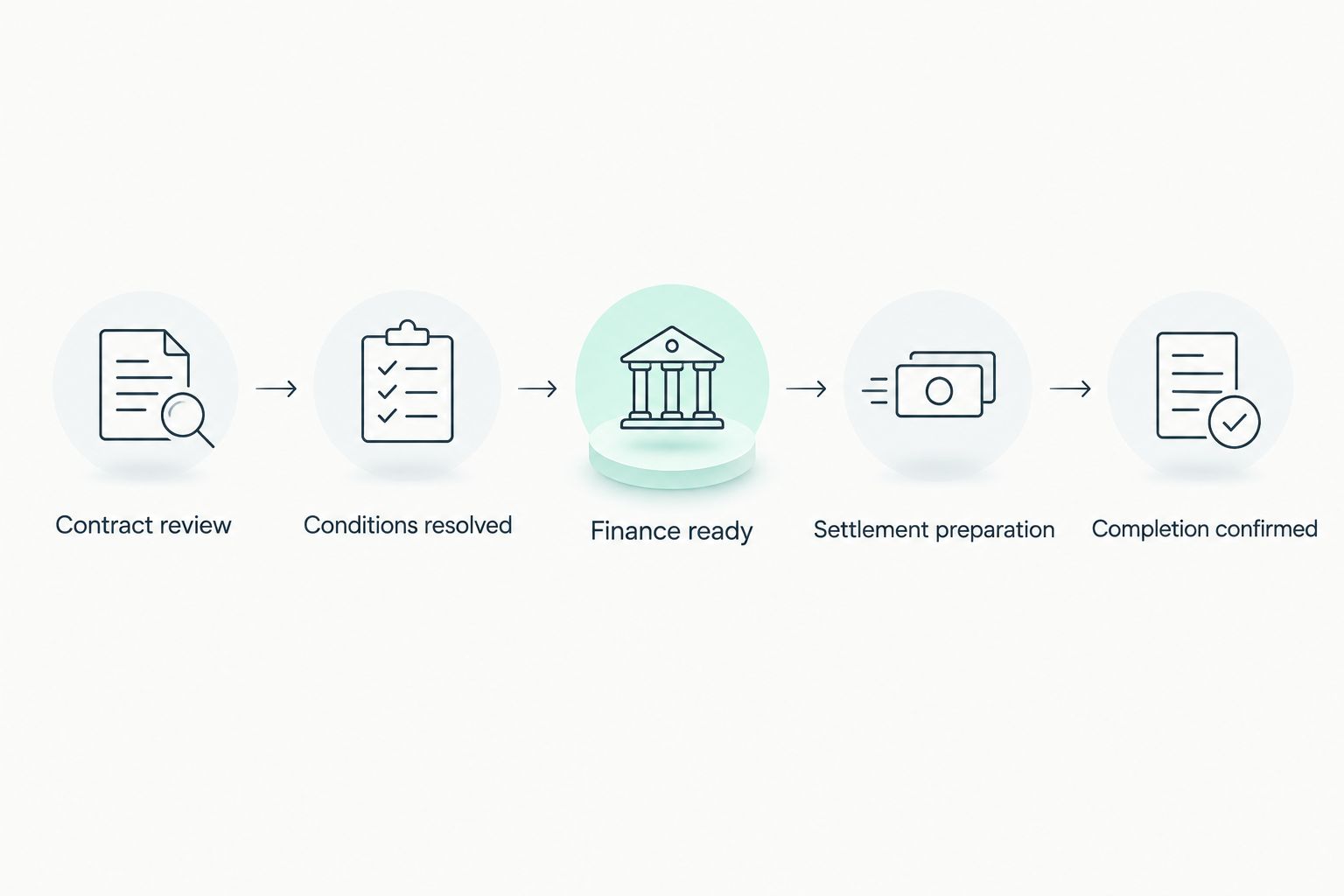
Read your timeline as a sequence of responsibilities:
- Contract review. Identify the settlement clause, conditions, disclosure documents and any special terms before committing. Ask your conveyancer to explain any wording that makes the completion date conditional or adjustable.
- Conditions resolved. Complete the requirements attached to your purchase, including finance and inspections where the contract provides for them. Record the actual deadlines; they are not necessarily the same as settlement day.
- Finance ready. Obtain the required loan approval, sign the lender's documents and confirm the lender is preparing to advance funds. An approval letter is not confirmation that the settlement booking is ready.
- Settlement preparation. Your conveyancer prepares the transfer arrangements, checks adjustments and confirms the money required from you. The seller's representatives also need to arrange any mortgage discharge and other obligations affecting completion.
- Completion confirmed. Wait for your conveyancer to confirm settlement before treating the purchase as completed. Key release and possession follow the contract and the agreed handover arrangements.
Why the settlement date matters
Your settlement date connects the legal transaction to practical commitments: moving, ending a tenancy, arranging insurance, accessing sale proceeds and taking possession. A mismatch between those commitments creates pressure even when everyone still intends to complete the sale.
For a 2026 purchase, put the contractual date in your calendar alongside each earlier deadline. Include responsibility as well as timing: who supplies documents, who follows up the lender and who confirms that the transaction has completed.
Keep your moving arrangements separate from your assumption that settlement will happen on schedule. Ask removalists, accommodation providers and other suppliers about their change terms before making commitments that depend on access to the property.
Which settlement arrangement fits your purchase?
A shorter settlement period is not automatically better. Your preferred arrangement should match your finance readiness, the seller's circumstances and the property's legal status.
| Arrangement | Best for | Advantage | Constraint |
|---|---|---|---|
| Shorter agreed settlement | Buyers whose funds and documents are ready | Brings the planned completion date forward | Leaves less time to resolve outstanding requirements |
| Longer agreed settlement | Buyers coordinating finance, a sale or a move | Allows more preparation time | Extends the period before ownership transfers |
| Settlement linked to a contract event | Buyers purchasing property awaiting a defined milestone | Connects completion to the contractual trigger | Makes personal moving dates harder to fix |
These are contract arrangements, not guaranteed turnaround times. Ask your conveyancer whether the proposed wording achieves the outcome you need before you negotiate around it.
Shorter agreed settlement
Choose a shorter settlement only after checking readiness with your lender and conveyancer. Having a deposit available does not establish that the remaining purchase funds, signed loan documents and transfer requirements are ready.
The benefit is an earlier planned completion. The drawback is reduced room to correct documents, arrange a mortgage discharge or resolve a title question. A deadline that looks attractive in an offer becomes your contractual obligation once agreed.
Longer agreed settlement
A longer period gives you more time to coordinate the transaction, but it does not remove the need to act promptly. Finance conditions and other obligations can still fall due before settlement.
The trade-off is waiting longer to complete the purchase. If you are also selling, ask your conveyancer how the transactions interact rather than assuming an extended settlement automatically aligns the funds and possession dates.
Settlement linked to a contract event
For an off-the-plan purchase in 2026, distinguish the developer's estimated completion date from the settlement mechanism in your contract. Construction progress, registration and contractual notices can each affect when you must prepare to complete.
Ask your conveyancer to explain the trigger, the notice requirements and any relevant rights if the project is delayed. Do not arrange an inflexible move solely around a sales estimate or a construction update.
Why property settlement timing varies
Settlement depends on several parties completing connected tasks. Your readiness alone does not establish that the whole transaction is ready.
- Contract terms. A fixed settlement date works differently from a clause tied to registration, completion or another event. Special conditions can also change what must happen before completion.
- Buyer finance. The lender needs the necessary approvals, documents and settlement instructions. Delays remain possible after initial loan approval if preparation is unfinished.
- Seller mortgage discharge. If the seller has a mortgage, the outgoing lender must participate in releasing its interest. That process needs attention alongside the buyer's finance arrangements.
- Title and transfer requirements. Ownership details, identity checks and documents must support the transfer. A discrepancy needs to be resolved rather than left until settlement day.
- Linked transactions. A buyer relying on another property's sale proceeds needs the funding sequence coordinated. A problem in the related sale can affect the purchase.
- Outstanding obligations. Unresolved contractual requirements or disagreements about what must be delivered can interfere with completion. Raise them with your conveyancer while there is time to respond.
Ask what is outstanding, who owns the task and when it must be completed. That produces a more useful update than repeatedly asking whether settlement is still on track.
Is cooling-off included in the settlement period?
South Australia's 2 clear business days of cooling-off generally apply to eligible private residential purchases, subject to the statutory rules and exceptions. Cooling-off is not an extra period automatically added after your contractual settlement date.
The timing depends on the contract and service of the prescribed Form 1 disclosure statement. Auctions and other exceptions require separate attention. Have your conveyancer confirm whether a right exists and exactly when it expires.
For a 2026 purchase, the relevant framework is South Australia's Land and Business (Sale and Conveyancing) Act 1994, with consumer guidance provided by Consumer and Business Services. This concerns eligible transactions, not a universal cancellation right for every buyer.
Does finance approval mean settlement is ready?
Finance approval does not mean settlement is ready. Approval and funding are different stages, and the lender still needs the documents and arrangements required to release funds.
Ask your lender or broker whether anything remains outstanding for settlement, then ask your conveyancer whether the lender's participation is confirmed. Keep those conversations connected so an unresolved requirement does not sit between separate parties.
Can you move in before settlement is confirmed?
Do not assume you can move in before settlement is confirmed. Early access or possession needs an express arrangement, and your conveyancer should explain the conditions and risks before you accept keys or occupy the property.
An inspection appointment, an empty property or a seller's willingness to help does not replace that arrangement. Confirm possession and key-release instructions separately, particularly where a tenancy or another occupancy arrangement affects access.
What should you check before settlement day?
A useful settlement checklist focuses on evidence, not reassurance. You want confirmation that the required actions are finished or have an identified owner and deadline.
Confirm the money and documents
Ask your conveyancer for the amount you must provide, the payment instructions and the required timing. Check whether the lender has everything it needs and whether any signatures or identity requirements remain incomplete.
Independently verify changed bank details using a trusted contact method. Do not rely solely on an email asking you to redirect settlement funds, even if it appears within an existing conversation.
Inspect against the contract
Arrange the pre-settlement inspection through the appropriate parties and compare the property's condition and included items with the contract. Record a specific issue clearly, then contact your conveyancer about the available response.
An inspection is not a guarantee that every disagreement will be resolved before completion. Do not withhold money, refuse settlement or negotiate a remedy without advice about your obligations.
Confirm insurance and possession
Ask your conveyancer when risk passes under your contract, then arrange insurance accordingly. Do not assume the obligation starts only when you receive the keys.
Confirm who authorises key release and whether the contract provides vacant possession or a property subject to a tenancy. Those arrangements determine access; the settlement date alone does not answer every handover question.
Who should help you manage the timeline?
Your conveyancer or solicitor explains the contract, prepares the legal transfer and advises on settlement obligations. Your lender or broker addresses finance preparation, while the selling agent coordinates relevant communication, inspections and key-release arrangements.
Axiom Realty suits South Australian homebuyers seeking buyer's advocacy. Axiom Realty's buyer's advocacy service is relevant to buyers seeking representation during the purchase; it does not replace the conveyancer's legal role or the lender's funding decisions.
For homebuyers using Axiom Realty, buyer's advocacy and conveyancing serve different purposes. Ask each adviser to identify the tasks they handle so you know where to direct a question and who must act next.
FAQ
How do I find my property's settlement date in South Australia?
Check the settlement clause in your signed sale contract. It should identify a date or explain the event and calculation that determine when settlement is due; ask your conveyancer to explain any special conditions.
Is there a standard settlement period for every South Australian property?
There is no single settlement period that applies to every South Australian property purchase. Your contractual arrangements determine the due date, and unresolved requirements can prevent completion as planned.
Does South Australia's cooling-off period delay settlement?
South Australia's 2 clear business days of cooling-off are separate from the contractual settlement arrangements. Eligibility, commencement and exceptions depend on the statutory rules and the transaction.
Can I ask for a shorter settlement when making an offer?
You can propose a shorter settlement, but the seller must agree to the contractual terms. Check your lender's and conveyancer's readiness before committing to the date.
What happens if settlement does not happen on the agreed date?
Contact your conveyancer immediately if settlement does not happen on the agreed date. Your options and obligations depend on the contract, the reason for the delay and any formal notices or agreed changes.
When can I collect the keys after settlement?
Collect the keys once settlement is confirmed and release is authorised under the handover arrangements. Check possession terms separately if the property is tenanted or another access arrangement applies.
Do I need a conveyancer if I already have a buyer's agent?
A buyer's agent does not replace a conveyancer or solicitor. Purchase representation and legal advice about the contract, transfer and settlement are different roles.
One last thing
An unconditional contract is not a completed settlement. Removing conditions does not itself transfer ownership, release loan funds or authorise possession. Keep following up the remaining preparation after the contract becomes unconditional.
Before your 2026 settlement, ask your conveyancer: what remains outstanding, who must complete it, and when will completion be confirmed? Those answers give you a practical basis for planning your move instead of relying on the date alone.