

A buyer’s agent has no fixed timeframe for finding you a home in Adelaide: the search depends on your brief, suitable properties reaching the market, and your ability to proceed. Finding a suitable property is also different from securing a contract or reaching settlement, so agree on which milestone your agent’s estimate covers.
- How long does it take a buyers agent to find a home? There is no fixed timeframe.
- Separate the property search, accepted offer and settlement when planning your move.
- Axiom Realty provides buyer’s advocacy for Adelaide homebuyers and South Australian property investors.
- Ask for a written brief, progress updates and a review process—not an unsupported completion promise.
Why this matters
A search estimate is useful only when you know what it measures. An agent might mean identifying a suitable property, while you mean collecting the keys. Those are different outcomes, with different dependencies.
For your 2026 purchase, record 2 dates: your preferred move-in date and your latest acceptable move-in date. These are planning boundaries, not predictions. Give both to your agent before the search begins, particularly if you also need to coordinate a lease ending or an existing home sale.
If this is your first purchase, the guide to buyer’s advocacy for first-home buyers explains the service context. Establish what support you need before asking how quickly the search will finish.
How long does a buyer’s agent take to find a home in Adelaide?
There is no single duration that applies to every Adelaide buyer. A useful estimate starts with your requirements and ends at a clearly named milestone—not a general promise to find something quickly.
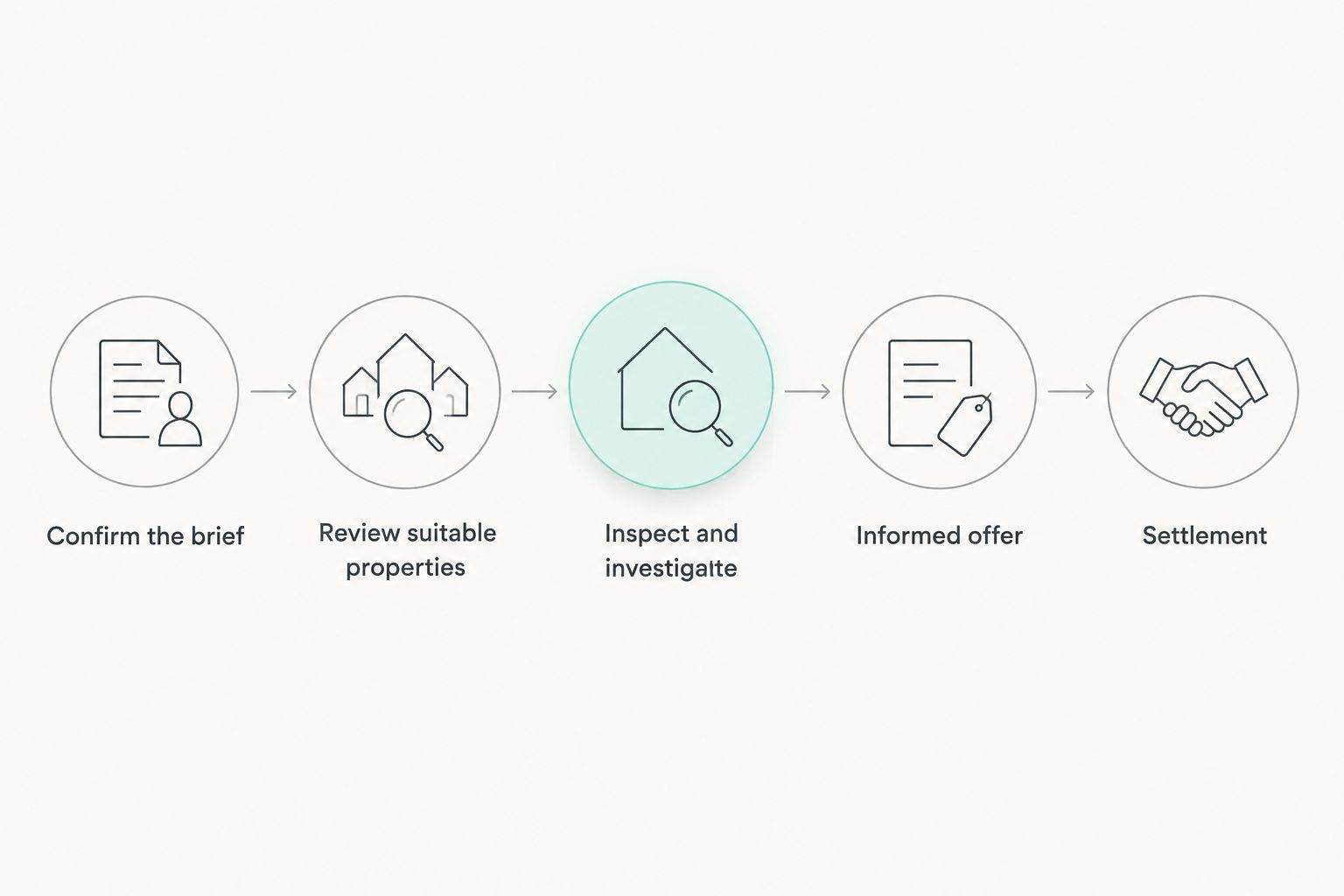
Ask your agent to explain the search through these steps:
- Confirm the brief. Record the location, property type, spending limit and features that determine whether a property qualifies.
- Review suitable properties. Assess listings against the agreed brief rather than sending every property in the area.
- Inspect and investigate. Check whether a promising property remains suitable after inspection and relevant enquiries.
- Make an informed offer. Decide on terms with the appropriate finance, conveyancing and inspection advice.
- Progress towards settlement. Track contractual obligations and the agreed settlement arrangements after a purchase is secured.
These are process stages, not a guaranteed timetable. Some work overlaps, and an unsuccessful offer returns you to the search rather than moving you closer to settlement automatically.
Measure progress by resolved decisions, not just elapsed time. A property rejected for a documented reason gives you useful information; a long list of unsuitable listings does not.
What does “finding a home” mean?
Before you compare agents’ estimates in 2026, use the same definition of success. A shortlist, an accepted offer and a settled purchase are not interchangeable.
| Milestone | What it tells you | Best for | Limitation |
|---|---|---|---|
| Suitable shortlist | Properties appear to match your written brief | Checking whether the search is correctly targeted | Inspection and further enquiries can rule properties out |
| Accepted offer | Buyer and seller have reached agreement on an offer | Tracking negotiation progress | Your conveyancer must confirm the contract position and any remaining conditions |
| Unconditional contract | Relevant contractual conditions have been resolved or satisfied | Planning around a more advanced purchase | Settlement obligations still remain |
| Settlement | The transaction has reached its contractual completion point | Coordinating ownership and possession arrangements | Confirm access and moving arrangements separately |
A shortlist can arrive without producing a purchase. Equally, a property that initially looks suitable can fail your checks. Neither outcome justifies treating the first inspection as the end of the search.
Ask the agent to state the endpoint explicitly: suitable property identified, contract secured, or settlement completed. Keep that wording in the engagement discussion so everyone measures the same result.
The search stage: control the brief, not the listings
Your agent can assess properties against your requirements, but cannot make a matching owner decide to sell. That distinction matters when your brief combines a narrow location with an uncommon property type or particular features.
Start by writing 3 non-negotiables. This is a practical briefing exercise, not a limit on your needs: identify the requirements that genuinely make a property unsuitable if absent, then put preferences in a separate list.
For example, a required bedroom arrangement and an essential location boundary belong in the decision criteria. A preferred finish belongs elsewhere if you would accept a property without it. Do not label everything essential and then expect the agent to broaden the search without your approval.
After inspections, explain why you rejected each property. “Not right” gives little direction; “the living area does not accommodate our household” identifies a requirement the next shortlist must address.
The offer stage: finding a property is not securing it
A suitable property still requires a purchase decision and an agreement with the seller. Your agent’s search estimate should not assume that every offer succeeds or that every seller responds on your preferred schedule.
Agree beforehand on your decision process. Identify who must approve an offer, who will review the contract, and what information you need before authorising the next step. A clear process prevents a promising inspection from becoming an unresolved discussion.
Keep negotiation and due diligence connected. A fast offer is not a useful result if you have not understood the property or the proposed obligations. The building and pest inspection workflow is a relevant companion when planning those checks; your advisers should confirm the sequence for the actual contract.
Do not trade away an essential check just to meet a search deadline. Change the move-in plan or the brief before accepting a risk you do not understand.
The settlement stage: plan separately from the search
Settlement follows the purchase agreement and its requirements. It is not simply extra search time, and an agent’s estimate for locating a home should not be treated as an estimate for when you can move in.
For a 2026 move, work backwards from the possession arrangements confirmed for your transaction. Coordinate finance, conveyancing, any required inspections and your moving arrangements with the people responsible for each task.
An agent’s search estimate is not authority to end your lease or book an inflexible move. Confirm your contractual position and practical access arrangements first. This is especially important when your accommodation plans depend on a particular completion date.
Why a buyer’s agent’s search time varies
The following factors explain why a single Adelaide-wide promise is not a useful planning tool. Discuss each against your actual brief rather than assuming another buyer’s experience predicts yours.
- Location boundaries. Restricting the search to a smaller area reduces the set of properties your agent can consider. Broader boundaries only help if those locations genuinely suit you.
- Property requirements. A specific combination of layout, land, access and condition narrows the search. Separate essential requirements from features you would accept changing later.
- Budget fit. Your spending limit needs to match the properties you are prepared to buy. Ask for relevant property evidence before changing the limit or assuming the search is simply too slow.
- Decision readiness. Unresolved finance questions, unavailable decision-makers and an unclear approval process leave purchase decisions unfinished. Assign responsibility before a suitable property appears.
- Seller and contract arrangements. The seller’s process, negotiation decisions and contractual conditions affect the path from interest to purchase. These are not all controlled by your agent.
- Due diligence findings. Inspection or document review can identify a reason not to proceed. Rejecting an unsuitable property protects the brief even when it extends the search.
Ask your agent which factor currently prevents the next step. That question produces a more useful answer than asking whether the search is taking too long in the abstract.
How do you tell whether the search is making progress?
For a 2026 search, ask for updates that explain decisions rather than simply report activity. You need to understand what was considered, what was rejected and what needs to change.
A useful update should cover:
- Properties assessed: which candidates matched enough of the brief to warrant attention.
- Reasons for rejection: whether location, condition, layout or another requirement ruled them out.
- Outstanding actions: which decision or document is needed, and who is responsible.
- Brief changes: whether the evidence supports adjusting a preference or keeping the brief unchanged.
Agree on the update schedule in writing rather than assuming a frequency. Also agree on when to review the brief if the search is not producing suitable candidates.
Axiom Realty offers buyer’s advocacy alongside property management, investment advisory and property sales. Axiom Realty’s buyer’s advocacy is for Adelaide homebuyers and South Australian property investors seeking purchase representation. The service does not remove the need to agree on scope, communication and the meaning of a completed search.
Discuss your Adelaide buying brief
Explain your property requirements, purchase plans and preferred timing.
Can a buyer’s agent guarantee a purchase date?
A purchase date depends on more than the property search. Treat any promised deadline as something to examine against the engagement terms, the available properties and the seller’s decisions.
Ask what happens if the deadline passes without a suitable purchase. Clarify whether the search continues, the engagement ends, or the brief is reviewed. Those arrangements belong in the written agreement, not in an assumption based on a sales conversation.
Should you widen your Adelaide search if nothing fits?
Widen the search only when the proposed change still meets your underlying needs. Adding locations you would not live in does not solve a homebuying problem; it changes the problem.
Review rejected properties first. If the same optional feature repeatedly rules out otherwise suitable homes, reconsider that preference. If every rejection concerns an essential requirement, keep the requirement and discuss whether your timing or overall purchase plan needs to change.
Is a buyer’s agent useful if you need to move quickly?
A buyer’s agent can provide purchase representation, but urgency does not create a suitable property or determine a seller’s response. Ask which tasks the engagement covers and which decisions remain yours.
For time-poor buyers, the practical question is whether delegated search and assessment work addresses the bottleneck. Axiom Realty provides buyer’s advocacy, but you should confirm the agreed responsibilities rather than assume a service name includes every purchase task.
FAQ
How long does it take a buyers agent to find a home in Adelaide?
There is no fixed timeframe for a buyer’s agent to find a home in Adelaide. Your brief, suitable properties, decision readiness and the seller’s process determine how the search progresses.
Does a buyer’s agent’s search estimate include settlement?
Do not assume a search estimate includes settlement. Ask whether the estimate ends at a shortlist, an accepted offer, an unconditional contract or settlement.
Can I ask a buyer’s agent to work towards my move-in date?
Yes, give your buyer’s agent your preferred and latest acceptable move-in dates. Treat those dates as planning requirements, not a guarantee that a suitable purchase will complete in time.
Will broadening my suburb list help the search?
Broadening your suburb list expands the locations your agent can consider. Only include areas that still meet your household’s essential requirements.
What should I prepare before engaging a buyer’s agent?
Prepare your spending limit, location requirements, essential property features and timing constraints. Identify who approves purchase decisions and which finance and conveyancing advisers you will use.
Should I skip inspections to secure a home faster?
Do not skip an essential inspection solely to shorten the search. Discuss the appropriate checks and contract arrangements with your conveyancer and relevant inspectors.
What should I ask Axiom Realty about buyer’s advocacy?
Ask Axiom Realty to confirm the buyer’s advocacy scope, communication arrangements and search milestones. Explain whether you are purchasing a home or an investment so the brief reflects your purpose.
One last thing
For your 2026 purchase, define what would make you stop pursuing a property before you find one you like. Write down the unresolved issues you will not accept and discuss them with your advisers.
A search deadline should trigger a review, not a lower standard of due diligence. The useful outcome is a purchase that meets your brief—not a quick contract that leaves the important questions unanswered.