
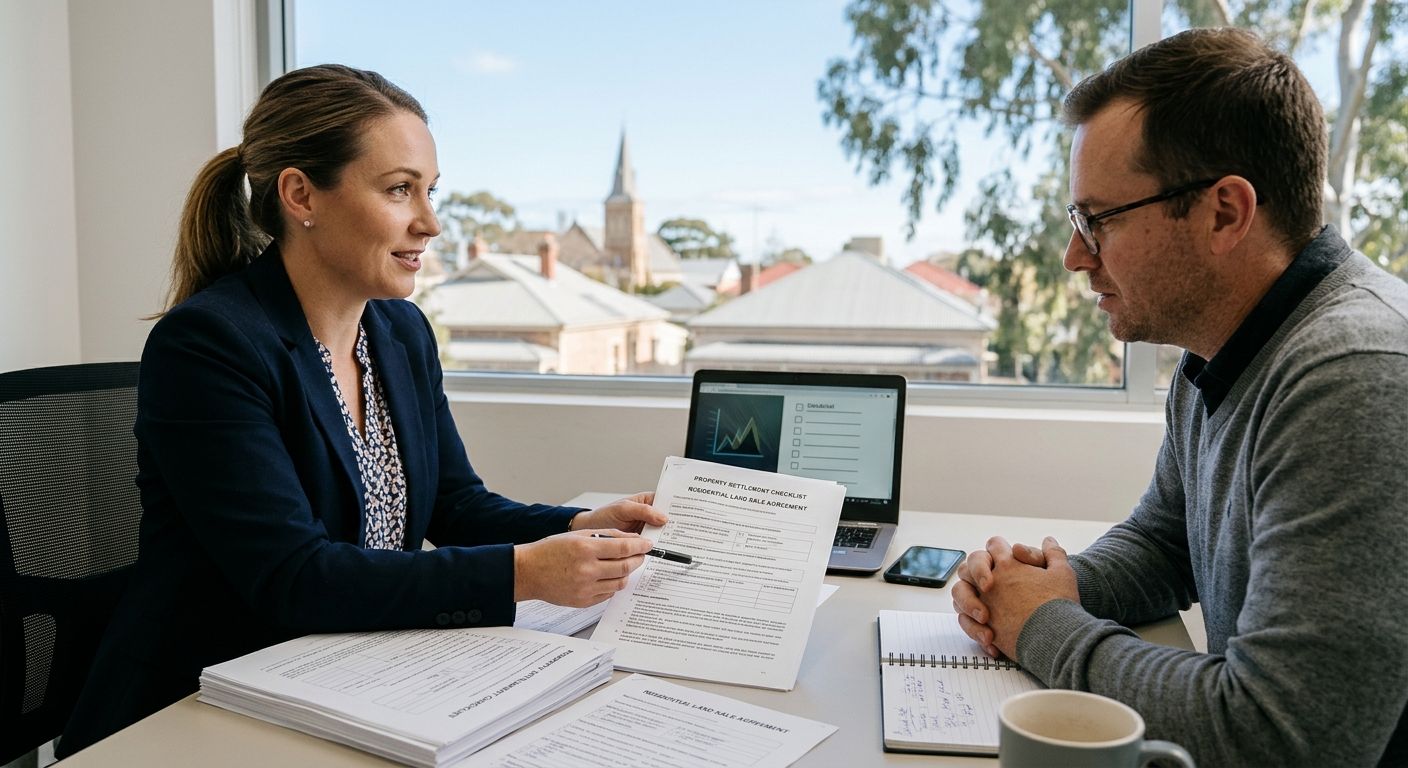
Instead of chasing insurance paperwork as settlement approaches, use an Adelaide building insurance valuation to settlement workflow that confirms your rebuilding estimate, cover start date and lender evidence in one purchase file. For a 2026 purchase, establish when you need cover before treating settlement day as the deadline.
- Adelaide building insurance valuation to settlement starts with contract risk timing, not an assumed settlement-day deadline.
- A rebuilding estimate serves a different purpose from a purchase price or lender valuation.
- Confirm the policy is active; a quote alone does not establish cover.
- Axiom Realty provides buyer’s advocacy for South Australian homebuyers; direct insurance and contract questions to the relevant specialists.
Why this matters
A bank valuation, an insurance rebuilding estimate and a settlement booking answer different questions. Mixing them up leaves you with paperwork that looks complete but does not establish what is insured or when cover begins.
Axiom Realty is best suited to South Australian buyers seeking property buyer’s advocacy, rather than insurance underwriting. Axiom Realty offers buyer’s advocacy and investment advisory services; your insurer confirms policy terms, and your conveyancer or solicitor explains your contract obligations.
The workflow below separates those responsibilities. Its benefit is a traceable handover between buyer, insurer, lender and conveyancer; its limitation is that a checklist cannot decide a disputed contract clause or establish an adequate rebuilding amount without property-specific information.
Before you start
- Gather the property records. Have the signed contract, property address, building details, inspection findings, proposed use and settlement information accessible. Include additions and outbuildings when describing the property to an insurer.
- Identify the decision-makers. You need your conveyancer or solicitor, insurer or insurance broker, and lender contact where finance applies. Ask who must receive evidence and what that evidence must show.
- Resolve the timing trap first. Do not assume the seller’s insurance protects you or that your responsibility begins at settlement. Have your conveyancer check the contract before selecting a policy commencement date.
For your 2026 purchase checklist, keep inspection issues beside the insurance records. The building and pest inspection to unconditional offer workflow covers the adjacent purchase process; an inspection report is not an insurance acceptance or rebuilding valuation.
Contract timing and purchase file
Establish the insurance deadline
- Ask your conveyancer to confirm the relevant contract position. Request written advice on when risk passes, what insurance obligations apply and whether possession arrangements change the position. Do not replace that advice with a general rule about Adelaide purchases.
- Record the required commencement date and time. Keep the contractual insurance deadline separate from the expected settlement date. Ask your insurer how the policy records commencement, particularly where the deadline falls before settlement.
- Create 3 records: contract timing, rebuilding basis and insurance evidence. Give each record an owner and keep the latest version accessible. Record who must act if the contract, property use or settlement arrangements change.
Expected result: you can identify the required insurance commencement point, the person who confirmed it and the evidence needed before that point.
Use document headings such as Contract timing, Rebuilding basis and Insurance evidence in your own purchase file. These are filing labels, not insurer portal controls; follow the actual labels and instructions in your insurer’s application.
Keep a short decision log rather than a long email chain. Record the question, the answer, who provided it and the date, so a revised settlement booking does not erase an earlier insurance instruction.
Rebuilding basis and cover scope
Separate the valuations
A property’s purchase price is not its rebuilding cost. Market value reflects land and market conditions, while building insurance concerns the insured structures and the policy’s stated cover.
Use this comparison when reviewing the valuation documents in your 2026 purchase file:
| Document or estimate | Best for | Benefit | Limitation |
|---|---|---|---|
| Market valuation | Assessing property value | Addresses the property in its market context | Does not establish an insurance rebuilding amount |
| Lender valuation | Supporting a lending assessment | Serves the lender’s security assessment | Does not confirm insurance adequacy or policy acceptance |
| Insurance rebuilding estimate | Assessing the cost basis for building cover | Focuses on reconstruction rather than land value | Depends on accurate inputs and the estimate’s scope |
| Building inspection report | Identifying reported condition issues | Helps identify matters requiring investigation or disclosure | Does not establish insured value or guarantee acceptance |
- Confirm what the rebuilding estimate includes. Ask how demolition, debris removal, professional fees, site access and applicable rebuilding requirements are treated. Check whether these sit within the building sum insured or under separate policy provisions.
- Check the property description against the actual buildings. Review construction, extensions, garages, sheds and other structures with the insurer. Do not assume every improvement is included because it appears on the same title.
- Escalate uncertain inputs. If a calculator cannot describe the property accurately, ask the insurer what assessment it requires. For specialist valuation advice, confirm the assessor’s relevant qualifications and the scope of the report before relying on it.
Expected result: the building sum insured has a documented rebuilding basis, with exclusions and unresolved assumptions identified rather than hidden.
Use the rebuilding assessment for insurance decisions, not the purchase price by default. A calculator provides a structured starting point, but unusual construction or difficult access needs more attention than selecting the nearest available answer.
Policy commencement and evidence
Confirm active cover
- Disclose the intended occupancy and known circumstances. Tell the insurer whether you will live in the property, rent it out, leave it unoccupied or undertake renovations. Answer application questions accurately and ask how any planned changes affect acceptance and cover.
- Check the issued policy documents. Review the insured parties, property address, commencement date, building sum insured, excesses, exclusions and endorsements. Ask the insurer to explain discrepancies rather than assuming a verbal discussion overrides the documents.
- Obtain the evidence your lender requires. Ask whether the lender needs a certificate of currency or another document, and whether its interest must be noted. Confirm the insurer has issued active cover; a saved quote or submitted application is not sufficient evidence by itself.
Expected result: you hold issued insurance documents that match the property and intended use, plus the evidence required by your lender.
Check 2 documents together: the policy schedule and the certificate of currency, where issued. The certificate summarises cover; the policy wording, schedule and endorsements explain its terms. Refer any inconsistency back to the insurer.
Insurance placement is separate from property buyer’s advocacy. Axiom Realty supports South Australian buyers through its advocacy service, while policy selection and acceptance remain matters to resolve with the insurer or an appropriately licensed adviser.
Settlement handover and change control
Close the evidence loop
- Send the required evidence to the nominated recipients. Give your lender the documents it requests and your conveyancer the insurance information relevant to their instructions. Ask for acknowledgement rather than treating an outgoing email as completion.
- Reconcile the final purchase details. Check the property address, ownership details, expected possession and intended use against the issued policy. Raise any mismatch before relying on the documents for settlement.
- Confirm the next responsibility after settlement. Keep insurer contact details and the policy reference accessible. If the property will become a rental, assign responsibility for notifying the insurer about occupancy changes and reviewing the relevant cover.
Expected result: each recipient has the required evidence, the policy reflects the agreed arrangements, and someone owns the next insurance review.
The sequence is contract advice, rebuilding assessment, active cover, then evidence handover. A settlement booking is not a substitute for completing those checks.
Keep the final handover record short: what was sent, to whom, when, and whether anything remains unresolved. Save superseded documents separately so nobody forwards an outdated certificate during the final settlement checks.
When settlement or property use changes
A delayed settlement does not automatically mean your existing policy needs a later start date. For a 2026 settlement change, first establish whether your contractual exposure or the insurer’s understanding of the property has changed.
- Recheck the contract position. Ask your conveyancer whether the revised arrangements affect risk, possession or any insurance obligation.
- Notify the insurer of relevant changes. Explain the revised dates and any changes to vacancy, tenancy, renovation plans or occupancy. Ask whether the policy needs amendment.
- Replace affected evidence. If the insurer amends the policy, obtain updated documents and send them to the recipients who need them.
Do not cancel or postpone cover solely because settlement moves. Confirm the contractual and insurance consequences first, then make the agreed change without creating an unintended gap.
For a strata or community-title purchase, obtain the corporation’s building insurance information and ask what it covers. Check responsibility for the lot, common property, improvements, contents and liability rather than assuming a shared policy covers every interest.
Troubleshooting
The lender has a valuation but still requests insurance evidence
A lender valuation does not prove an insurance policy exists. Ask the lender to specify the required document and details, then request those from the insurer rather than resending the valuation.
The insurer’s estimate differs from your purchase price
Check what each figure measures before treating the difference as an error. Review the rebuilding inputs and included costs; do not force the building sum insured to match the contract price simply to make the figures agree.
The certificate shows the wrong address or insured party
Ask the insurer to correct the underlying policy record and reissue the affected documents. Do not edit the certificate yourself or assume an email explanation cures an incorrect policy schedule.
The property will be vacant or renovated after purchase
Tell the insurer before relying on cover for those circumstances. Ask about conditions, restrictions and notification requirements, and obtain written clarification where the policy wording does not resolve your question.
A defect appears during the final inspection
Notify your conveyancer promptly and ask the insurer whether the information affects the application or issued cover. Do not assume a new policy pays to repair a known pre-existing defect; establish both the purchase-contract response and the insurance position.
Customise your workflow
Best for first-home buyers: add a plain-language decision log showing which questions belong to the conveyancer, lender and insurer. This reduces conflicting instructions, but it does not remove your responsibility to read and approve the documents.
Best for property investors: add an intended-use checkpoint before settlement and another before tenancy begins. Building cover and landlord-related cover address different risks; ask the insurer which protections and exclusions apply to your actual letting arrangements.
Best for apartment buyers: keep corporation insurance records beside your own policy documents. Shared building insurance simplifies some administration, but responsibility for individual improvements and other interests still needs checking.
Axiom Realty offers investment advisory and property management alongside buyer’s advocacy. Keep those property services separate from specialist insurance advice, and assign the insurance review to a named person rather than leaving it between advisers.
FAQ
When should I arrange building insurance before an Adelaide settlement?
Arrange building insurance to begin when your contract position and circumstances require it, as confirmed with your conveyancer and insurer. Do not assume settlement day is the correct commencement date.
Is a bank valuation enough for building insurance?
No. A bank valuation serves a lending assessment and does not establish an adequate insurance rebuilding amount. Confirm the rebuilding basis and policy requirements separately.
Should I insure the building for the purchase price?
Do not use the purchase price as the rebuilding amount by default. Purchase price includes land and market influences, while the insurance assessment concerns rebuilding and the costs covered under the policy.
Does a building insurance quote prove I am covered?
No. A quote does not by itself establish active insurance. Confirm acceptance, the commencement date and the issued policy documents with the insurer.
What happens to insurance if settlement is delayed?
Recheck the revised arrangements with your conveyancer and insurer before changing cover. Notify the insurer about relevant changes and replace lender evidence if the policy is amended.
Do Adelaide apartment buyers need their own building insurance?
Check the corporation’s policy and your individual responsibilities before deciding what additional cover you need. Confirm how the documents treat common property, improvements, contents and liability.
Can Axiom Realty arrange my insurance policy?
Axiom Realty’s stated services are property management, investment advisory, property sales and buyer’s advocacy. Direct insurance placement and policy advice to an insurer or an appropriately licensed insurance adviser.
One last thing
A complete insurance file can still contain the wrong start date. Before closing your 2026 purchase checklist, compare the issued commencement date with your conveyancer’s written advice—not just the settlement booking. That check connects the legal deadline to the policy you actually hold.